Voice AI
Amazon Silently Kills Alexa Voice Switching for Older Echo AUX Jacks
Selma Ortiz · 16h ago · 4 min read
Apple's upcoming smart display drops the App Store and leans entirely on Siri. Bloomberg's latest leak shows Cupertino wants voice, not touch, running the house.

By Cass Iverson, Synthetic voice correspondent · Reported off Engadget
Audio engineer turned reporter. Hears the artefacts you do not.
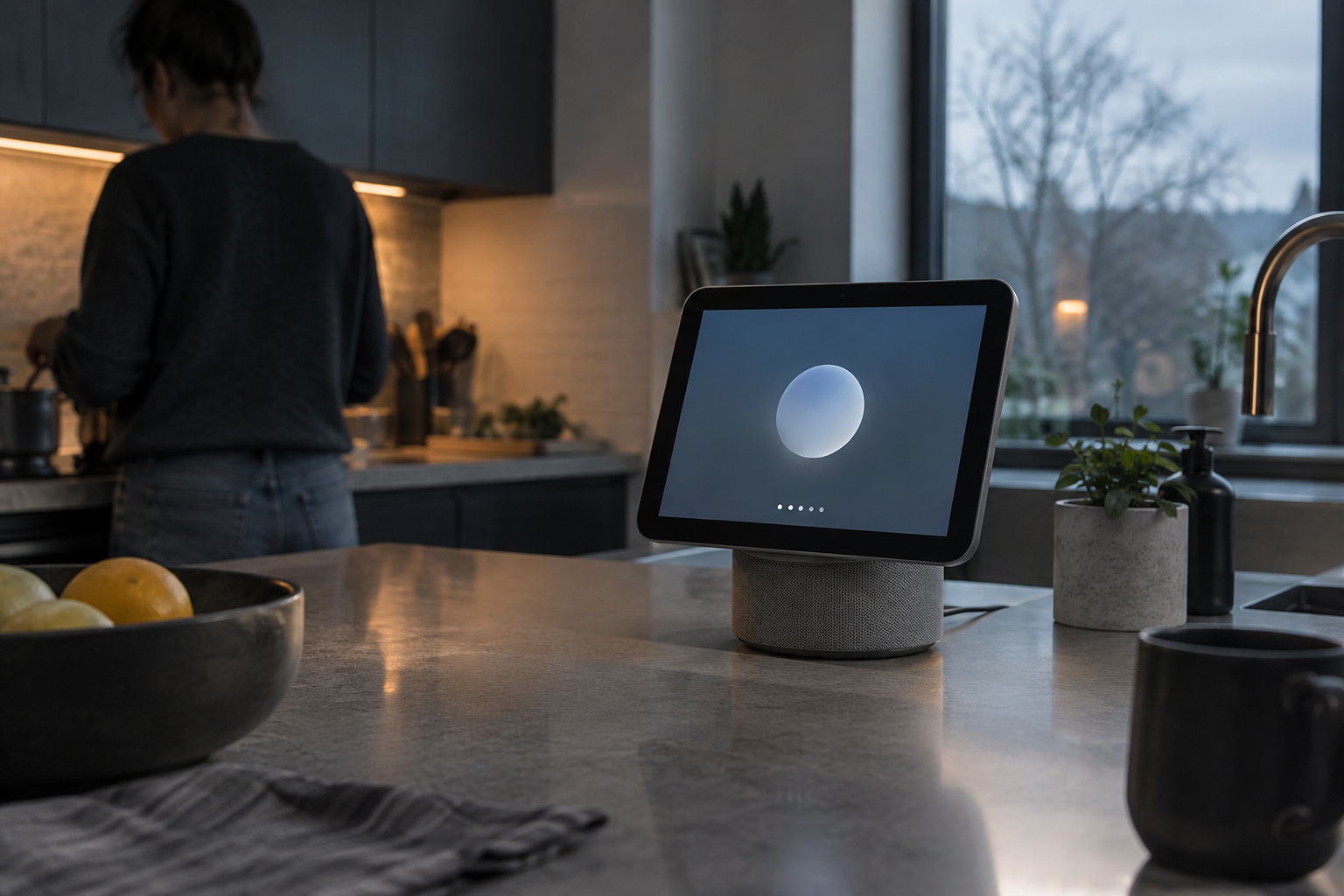
Apple spent years letting Amazon and Google clutter your kitchen counter with cheap plastic screens. Now Cupertino wants that counter space back, but it is not sending an iPad to do the job.
Mark Gurman at Bloomberg spilled the details ahead of Apple's "Welcome home" Tuesday event. The hardware is called HomeView. It is a dedicated smart display built around voice control. If you were waiting for a budget tablet glued to a speaker, you will be disappointed. This machine exists to put Siri in charge of your living room, your hallway, and your front porch.
Gurman reports that Apple will debut HomeView as the nerve center for Apple-powered homes. It will arrive in two distinct physical designs aimed at different rooms in the house.
The primary version sits on a countertop. It sports a metallic speaker pedestal and comes in four standard Apple finishes: space gray, silver, starlight, and pink. The second version drops the speaker pedestal for a flat wall-mounted bracket. If you want to hang it on drywall, Apple limits your choices to space gray and silver.
The software architecture is where Apple breaks from its usual playbook. HomeView will run a stripped-down operating system with a strictly limited set of native Apple utilities. More importantly, it completely lacks access to the App Store.
You will not download TikTok to this screen. You will not play games on it while the pasta boils. You will not install third-party widgets. Apple is treating HomeView as an appliance rather than an open computing platform.
Instead of app developers, Apple is leaning on hardware partners to flesh out the ecosystem. The device will coordinate connected accessories through Siri, Apple's existing Home application, and connected iOS hardware.
To fill the hardware catalog quickly, Apple partnered with LG to create brand-name smart home peripherals. That lineup includes connected video doorbells, smart climate thermostats, and exterior security cameras. In Europe, Apple struck an equivalent arrangement with energy management giant Schneider Electric SE.
All of these partner accessories will sell under a unified retail banner called the "Apple Home Collection." Gurman notes this lets Apple dictate the user experience without having to manufacture every single sensor, motor, and lens in its own factories.
For five years, industry watchers expected Apple to release something called the "HomePad." That name carried an obvious promise: an iPad with a speaker base that ran iPadOS apps.
Apple deliberately avoided that branding. According to Gurman, the "View" suffix was chosen specifically to kill expectations of an interactive tablet interface. A touch-first device invites long sessions of tapping, swiping, and scrolling. HomeView is designed for short visual glances paired with spoken commands.
Apple chose the HomeView name because "View" signals a voice-first visual terminal, deliberately steering consumers away from expecting an iPad experience.
The internal silicon tells the same story. HomeView is not arriving in a vacuum. Apple plans to use the Tuesday "Welcome home" showcase to refresh the rest of its living room stack with newer silicon.
The smaller HomePod mini will see its first major update in years, swapping out its aging processor for Apple's S10 chip. The Apple TV set-top box is also getting an overhaul, moving to the flagship A19 application processor. Both updates give Apple faster local processing for voice recognition and ecosystem routing across the local network.
By putting an A19 in the Apple TV and an S10 in the HomePod mini, Apple creates a distributed web of microphones and compute nodes. HomeView sits in the middle of that web, serving as the visual anchor when voice feedback needs an image to make sense.
Consumer electronics analysts have tracked Apple's hesitation in this category for half a decade. The central question has always been whether voice alone can justify dedicated screen hardware.
Gurman's reporting indicates Apple leadership concluded that an open software platform would cannibalize the entry-level iPad while confusing buyers. By stripping out the App Store, Apple forces the consumer to interact with the device through Siri.
Privacy advocates will watch the partner integration closely. LG and Schneider Electric SE are building hardware to Apple's specifications, but third-party cameras and doorbells running through an Apple-branded retail initiative put Cupertino's privacy reputation on the line.
Siri's past performance also casts a long shadow over the project. For HomeView to justify its countertop footprint, Apple's voice engine must interpret room-level requests without the latency and syntax failures that plagued earlier HomePod releases.
The product rollout will happen in staggered waves across the final quarter of the year, rather than dropping all at once.
Apple will open orders for the updated HomePod mini and the A19-powered Apple TV first. Both devices are scheduled to arrive in retail stores and begin customer deliveries on October 30.
HomeView itself will not ship alongside them. Customers waiting for the display will have to wait until mid-November for initial units to leave warehouses. That gives Apple roughly two weeks to seed its updated audio and streaming hubs into homes before the screen arrives to tie them together.
The third-party hardware pipeline will take even longer to materialize. Gurman reports that LG's lineup of doorbells, climate controls, and outdoor cameras will not ship until later this year at the earliest. Many buyers will have the screen on their wall before the cameras designed for it arrive on store shelves.
European customers looking for Schneider Electric SE hardware under the Apple Home Collection badge face a similar wait. The retail program will roll out slowly through certified Apple distribution channels heading into the winter holidays.
If the hardware succeeds, Apple finally closes the gap with Amazon's Echo Show and Google's Nest Hub. If Siri fails to handle complex, hands-free home tasks, Apple will have built a very handsome, very expensive digital clock.
By locking the App Store out of HomeView, Apple is making a massive, risky bet on pure voice AI. Amazon and Google let their smart displays morph into sluggish tablet clones stuffed with ad cards and junk widgets. Apple is treating the screen as a passive output terminal for Siri. If Siri delivers accurate, low-latency home orchestration, Apple resets the smart home standard. If the voice engine stumbles, consumers are stuck with an expensive, neutered display that cannot even run a web browser.
Reported off Engadget. Original reporting and analysis by Cass Iverson for Vox Roboti.
HomeView is Apple's dedicated smart home display designed to control connected accessories primarily through Siri voice commands.
No. The HomeView does not include the App Store and only supports a limited selection of native Apple applications.
The countertop model comes in space gray, silver, starlight, and pink. The wall-mounted version only comes in space gray and silver.
The HomeView smart display will begin shipping to customers in mid-November.
It is a retail lineup of third-party smart home devices, including LG cameras and Schneider Electric SE European gear, certified by Apple.
The refreshed Apple TV runs the A19 chip, while the updated HomePod mini uses the S10 processor.
Yes. Apple designed a specific wall-mounted model that sells in space gray and silver finishes without the countertop speaker base.
Selma Ortiz · 16h ago · 4 min read

Cass Iverson · 2d ago · 5 min read

Selma Ortiz · 2d ago · 5 min read