Voice Agents
Google Drops the Fitbit Edge and Tightens the Hardware Trap
Priya Raghunathan · 2d ago · 5 min read
Cerebras chief Andrew Feldman says dedicated home AI hardware running hybrid edge-cloud agents will soon manage household tasks and hold your credit cards.

By Priya Raghunathan, Enterprise correspondent · Reported off TechCrunch AI
Covers buyers, contracts and pilots that quietly died.
Silicon executives rarely pitch consumer appliances unless they see a massive compute bottleneck they can monetize. On October 13, 2026, Cerebras Systems chief executive Andrew Feldman took the stage at TechCrunch Disrupt in San Francisco to tell consumers their next home appliance will not clean floors or toast bread. It will run their lives through autonomous local agents.
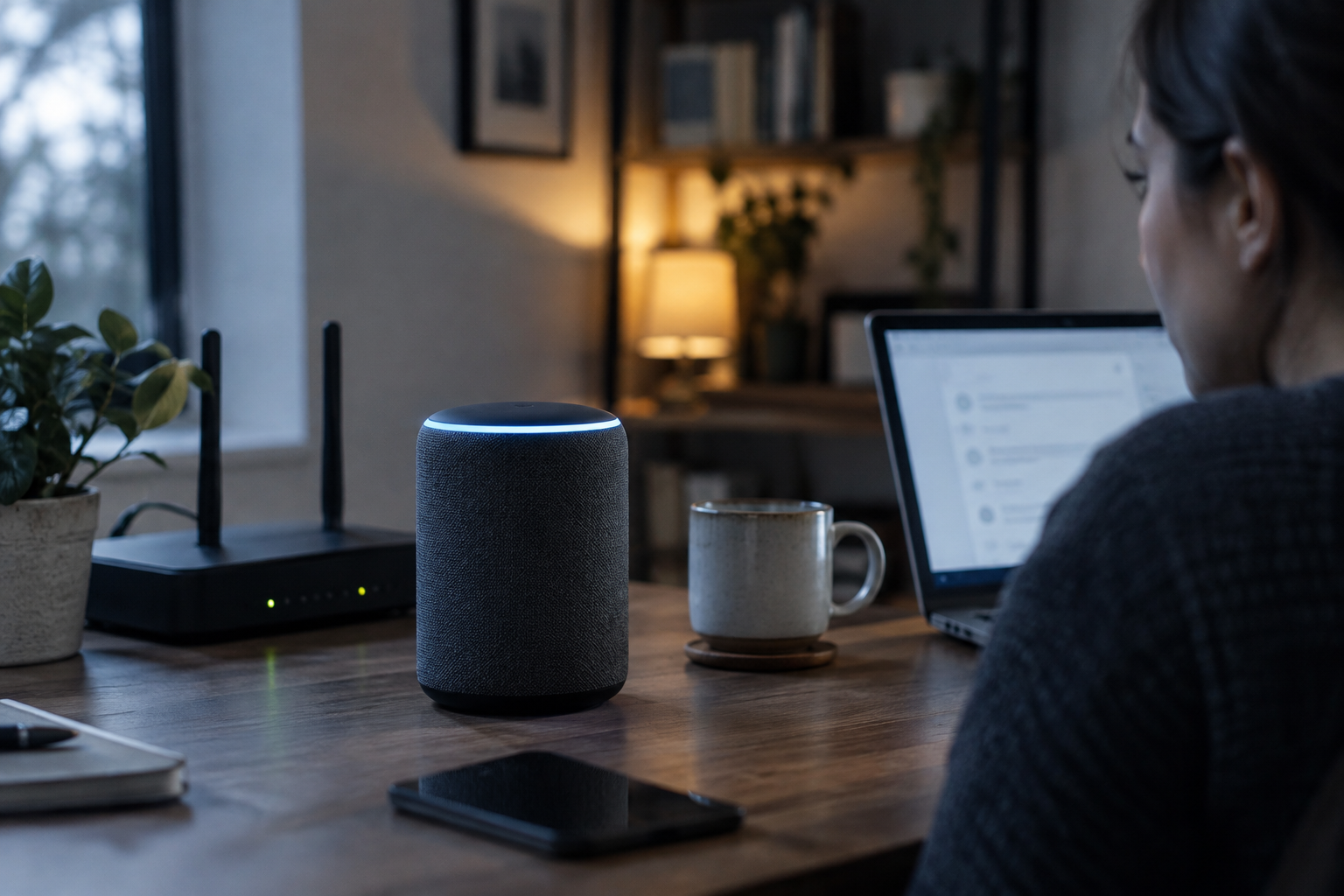
Feldman told the Disrupt audience that dedicated home hardware running personal artificial intelligence is arriving far faster than mainstream enterprise roadmaps indicate. The architecture he outlined strips away the standard smart speaker model of passive cloud streaming. Instead, it relies on dedicated household hardware capable of executing local inference before sending overflow queries to remote servers.
This is not a voice assistant that reads Wikipedia entries aloud. Feldman specified that these upcoming home systems will hold direct authorization over personal payment credentials. They will possess full clearance to purchase physical goods, settle bills, and manage daily financial transactions on behalf of the homeowner without requiring immediate human intervention for every micro-transaction.
To prove consumer readiness, Feldman cited the rapid commercial rollout of Meta's Muse and the explosive growth of Instinct, an agentic startup that recently crossed a $10 billion private market valuation. Those tools proved consumers want delegation, not just text generation. The shift now moves from software operating inside phone glass to persistent appliances operating inside domestic walls.
Cerebras built its balance sheet on massive wafer-scale processors engineered to bypass standard datacenter clusters. Feldman spent the last decade building dinner-plate-sized silicon to train enormous neural networks for institutional clients. His sudden pivot to domestic edge appliances signals a calculated shift in where inference computation will actually occur over the next five years.
Up to this point, voice hardware meant thin clients. Amazon Echo and Google Nest hardware carried cheap microphones, low-power microcontrollers, and barely enough digital signal processing to recognize a wake word. Every meaningful syllable traveled straight to a remote datacenter. That design created three systemic points of failure: unacceptable latency, massive recurring server bills for the provider, and relentless privacy exposure for the household.
Feldman's proposed architecture mirrors the compute split modern smartphones use to process biometric data and photo pipelines. Heavy training stays in centralized datacenters. The immediate operational processing happens on local silicon sitting in the living room, isolated behind physical home networking equipment:
The economics driving this shift are clear. Centralized hyperscalers cannot sustain the energy and server load of running billion-parameter context engines for hundreds of millions of consumers twenty-four hours a day. The compute bill must be offloaded to consumer electric meters and localized hardware units, or the agent economy collapses under cloud inference costs.
Feldman made no attempt to disguise the mechanics of the system during his Disrupt appearance. He stated directly that consumer agents must break free from pure cloud tethering to become reliable daily tools.
Just like your cell phone, they'll do some work on device and some work going back to the cloud. But I think they will get to know you very well, and you will have a security perimeter around them. And they will certainly have access to credit cards and be able to buy things for you.
Feldman also dismissed the idea that these tools remain experimental toys for early adopters. He detailed his own reliance on custom agent workflows, noting that he currently deploys a dedicated collection of autonomous agents to crawl his daily schedule, scrape contextual background files, and compile behavioral dossiers on individuals before every executive meeting.
Crucially, Feldman stated that Cerebras has no intention of manufacturing the consumer chassis or coding the end-user mobile interface. He framed his mission strictly around supplying the underlying compute infrastructure, deliberately leaving consumer-facing software designs and industrial chassis development to external venture-backed founders.
Investors backing agent ecosystems view the edge-appliance model as the only viable exit from datacenter power constraints. Software founders building on platforms like Instinct have discovered that users refuse to grant cloud-hosted web wrappers permanent access to bank accounts and confidential family data. Putting the brain on a physical desk inside the owner's home resolves the compliance deadlock.
Hardware manufacturers will now race to package inference silicon into stand-alone domestic hubs. Over the next twelve to eighteen months, expect hardware announcements combining medium-sized local language models, local solid-state context storage, and hardwired Ethernet connectivity meant to sit beside home routers.
The real battleground will be the payment gateways. Visa, Mastercard, and commercial clearing houses must deploy cryptographic protocols that permit localized machine agents to execute financial transactions without triggering fraud lockouts. Feldman's vision of agents holding credit card credentials requires an entirely new framework for delegated digital authority.
Consumer privacy will split into two distinct tiers. Buyers who can afford dedicated thousand-dollar home AI appliances will keep their personal context, calendar histories, and purchasing profiles on local flash memory. Consumers who rely on free or subsidized smartphone apps will continue paying for cloud intelligence by trading away their personal telemetry to hyperscale advertising platforms.
Software engineers must also resolve the synchronization problem. Running a fleet of agents that monitor household logistics, screen external calls, and audit calendars requires continuous state replication between the stationary home appliance and the mobile phone in the user's pocket.
Feldman's infrastructure thesis will face its trial in the enterprise and luxury consumer spaces first. Silicon providers will prioritize high-margin home hubs for high-net-worth professionals who require zero-exposure meeting prep and automated personal procurement before these devices trickle down to the general retail market.
The era of thin-client smart speakers streaming unencrypted family audio to corporate datacenters is closing. By pushing compute to local household silicon, the industry resolves the crippling cloud costs of agentic inference while creating a hardened perimeter for autonomous wallet delegation. If agents cannot touch local payment rails securely, the commercial voice AI revolution stalls out.
Reported off TechCrunch AI. Original reporting and analysis by Priya Raghunathan for Vox Roboti.
It is a dedicated domestic hardware unit that runs local AI models to manage tasks, household logistics, and purchases without sending all data to the cloud.
Yes. Andrew Feldman confirmed these systems will store payment credentials and hold authority to purchase products autonomously on behalf of the user.
They operate behind a domestic security perimeter, processing sensitive personal context and financial keys locally on device while outsourcing heavy non-private computation to cloud datacenters.
No. Feldman explicitly stated Cerebras focuses strictly on processing infrastructure, leaving consumer hardware enclosures and end-user software designs to external startup founders.
Feldman pointed to Meta's Muse and startup Instinct, which recently achieved a $10 billion valuation, as proof that everyday users are embracing agentic tools.
Feldman uses an automated collection of agents to sweep his calendar and assemble informational briefing dossiers on people before every scheduled business call.
Priya Raghunathan · 2d ago · 5 min read
Nina Falco · 3d ago · 5 min read
Devon Achebe · 4d ago · 4 min read