Voice AI
Amazon Silently Kills Alexa Voice Switching for Older Echo AUX Jacks
Selma Ortiz · 15h ago · 4 min read
Apple's 27.2 operating system updates give Siri conversation recall, deep file indexing, and five new languages across modern hardware.

By Devon Achebe, Infrastructure reporter · Reported off Engadget
Follows latency, cost and the parts of the stack vendors hide.
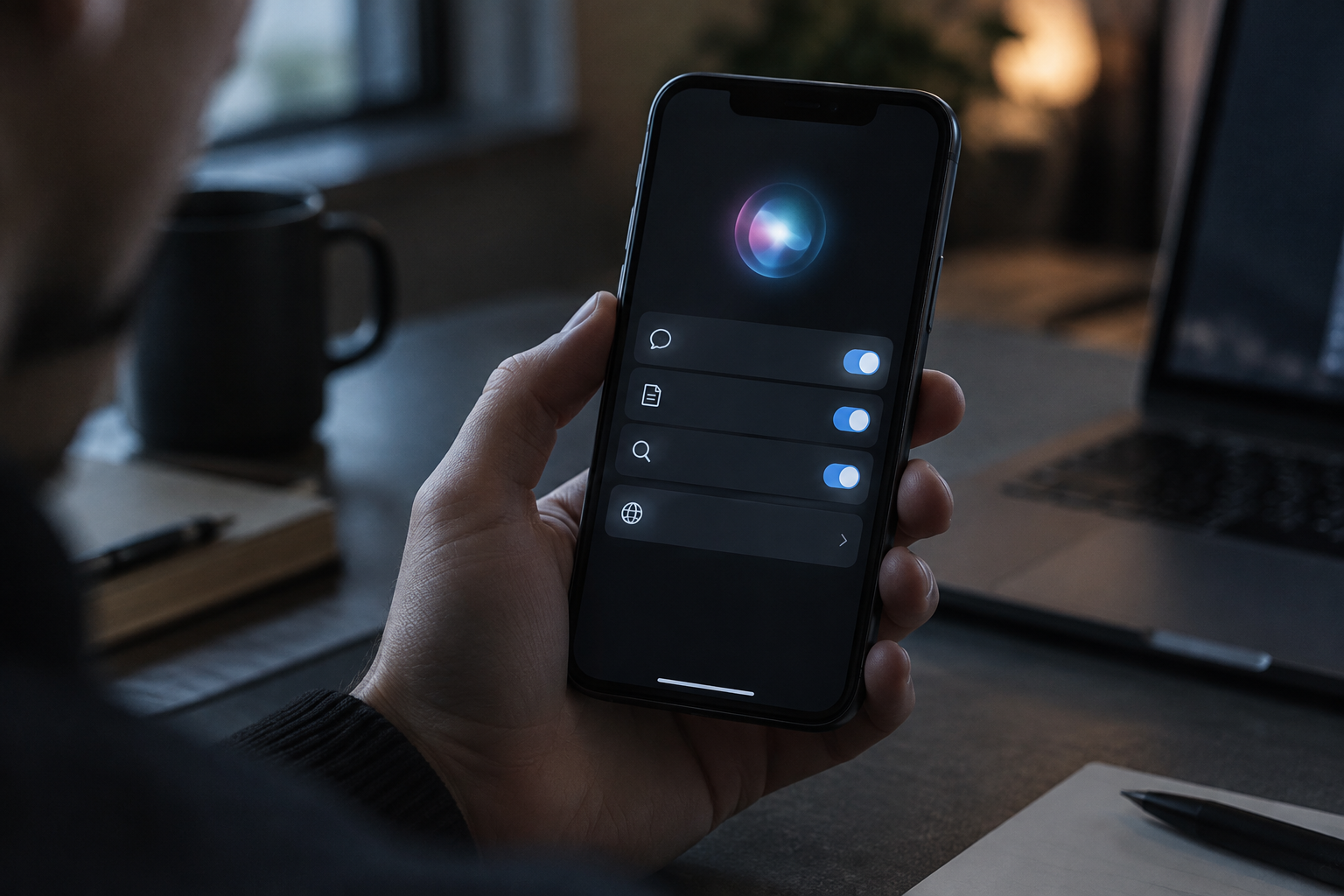
Apple pushed its 27.2 software tier out the door on October 26, 2026. The deployment covers iOS, watchOS, macOS, iPadOS, tvOS, Vision Pro, and HomePod. The headline changes belong to Siri.
The assistant can now remember what you told it five minutes ago. On compatible hardware, Siri AI retains context from past dialogues instead of wiping the slate clean after every prompt. If you spent ten minutes troubleshooting a flight booking earlier in the morning, the agent no longer treats your follow-up query like a cold call from a stranger.
Memory is only half the equation. Apple gave the assistant permission to dig through deeper personal silos across the operating system. Siri now mines information from three specific sources it previously ignored:
To keep users from panicking over that level of system inspection, Apple added an Excluded Apps toggle inside settings. Flipping that switch cuts Siri, Spotlight search, and predictive suggestions off from whatever specific software you want isolated.
Interacting with the generated text also changed. Users can now highlight and copy granular snippets of Siri AI responses directly on screen, rather than taking an all-or-nothing block of text.
International users finally get access. Apple expanded Siri AI support to five additional languages: French, Japanese, Korean, Portuguese, and Spanish.
The hardware barrier remains steep. These Siri AI capabilities are reserved strictly for the iPhone 15 Pro, iPhone 15 Pro Max, and all iPhone 16 models or newer. If you are holding an older base-tier handset, your assistant remains as forgetful as it was yesterday.
Every device receiving iOS 27.2 gets a secondary slate of general upgrades. The Photos app now allows users to edit captions and comments directly within Shared Albums. Messages gained context-aware Suggestions designed to recommend actions based on incoming text threads. Apple also integrated Google's SynthID watermarking standard into both Photos and Image Playground, allowing the operating system to spot synthetic and modified imagery generated by AI engines.
The company did not leave its first foldable out of the patch notes. The iPhone Duo received two tailored upgrades inside iOS 27.2: active support for the Apple Pencil, and Edge Light, a feature migrated from macOS that illuminates the display borders to mimic a ring light during video conferences.
Apple mirrored the Siri AI updates over to watchOS 27.2, giving compatible smartwatches the exact same feature lineup. On the desktop side, macOS 27.2 incorporates conversation recall and Messages Suggestions alongside typical security patches.
For more than a decade, voice assistants operated like fast food drive-through intercoms. You placed an order, received an output, and the system immediately dumped its short-term memory cache. If you asked about a restaurant reservation and then asked for driving directions thirty seconds later, the software treated the two requests as unrelated events in human history.
That architectural limitation made complex voice computing impossible. Competing platforms spent the past two years shoving large language models into mobile silicon to fix the amnesia problem. Apple took a conservative route, delaying deep contextual tracking until it could process the data locally or route it through private compute infrastructure.
The addition of granular data harvesting marks a major shift in how Apple indexes personal files. Historically, Siri only scanned surface-level metadata: dates, broad app categories, and address book names. By allowing the model to parse the visual contents of images sent in Messages, cross-reference calendar invitees, and process audio transcripts from voicemails, Apple is bridging the gap between passive storage and active agent memory.
Apple is bridging the gap between passive storage and active agent memory.
The hardware requirements explain why older devices are left behind. Scraping voicemails, running multi-turn contextual tracking, and handling local language translation models requires significant unified memory and neural engine throughput. Restricting the AI features to the iPhone 15 Pro, 15 Pro Max, and the iPhone 16 generation proves that Apple refuses to run these specific voice pipelines entirely in the cloud.
Adopting Google's SynthID represents an unusual point of ecosystem convergence. Synthetic media detection has been fragmented across conflicting standards for years. By building Google's watermarking protocol directly into iOS 27.2's Photos and Image Playground apps, Apple acknowledged that proprietary walled gardens cannot solve the problem of tracking generated media on their own.
Engadget reporter Anna Washenko detailed the software drop, zeroing in on the sheer volume of operating systems updated in a single afternoon. Observers tracking Apple's platform rollout immediately highlighted the contrast between the broad 27.2 system patch and the narrow hardware eligibility list for the actual intelligence tools.
Privacy-focused critics are looking closely at the Excluded Apps setting. Giving an assistant permission to parse personal voicemails and inspect private images sent over Messages changes the risk profile of everyday device use. While Apple built the toggle to allow users to wall off sensitive platforms, security analysts point out that opt-out configurations rely on user vigilance. If an owner does not actively configure their exclusion lists, Siri AI will treat those newly accessible data silos as open territory for background indexing.
Mobile productivity users have responded favorably to the inclusion of granular text selection in Siri interfaces. The inability to copy specific lines of an assistant's answer was a longstanding user interface headache that forced people to copy entire paragraphs into notes apps just to extract a single address or number.
International observers noted that expanding beyond English to French, Japanese, Korean, Portuguese, and Spanish removes a massive adoption bottleneck. Siri AI had been functionally irrelevant across major portions of Europe, Asia, and South America due to single-language limitations.
Foldable enthusiasts focused entirely on the iPhone Duo notes. The arrival of Apple Pencil compatibility and the Edge Light video tool addresses long-standing complaints that the dual-screen hardware lacked software utilities tailored to its physical form factor.
Now that Siri possesses conversational persistence, the baseline expectation for voice interaction changes. Users will no longer tolerate having to restate context during extended multi-step requests. When an assistant claims to remember, users expect it to connect dots across different days, different apps, and different communication channels.
That expectation creates immediate friction around data accuracy. Parsing calendar attendee lists to surface meeting notes works well when calendar invites are clean. It fails when calendar invites are messy, outdated, or filled with automated bot accounts. The same risk applies to voicemail indexing. Siri must accurately transcribe garbled audio, decipher accents, and pull correct dates without hallucinating appointments into existence.
The hardware split will accelerate upgrade pressures. Millions of active iPhone users are carrying base iPhone 14, 15, or older devices that can download iOS 27.2 but cannot touch the conversation recall tools. As Apple expands these voice-driven workflows, the divide between owners of standard hardware and owners of Pro or newer silicon will widen.
Developers will also have to adapt to the Excluded Apps perimeter. If users begin routinely walling off third-party communication tools, those apps lose their visibility inside system-level search and predictive suggestions. App makers must convince their users that letting Siri index their local data provides enough tangible value to justify keeping the access switch on.
The cross-platform rollout across watchOS and macOS signals that Apple intends to unify the assistant's memory across personal ecosystems. A conversation started on an Apple Watch during a run will eventually need to feed seamlessly into the desktop environment running macOS 27.2. Whether Apple's local-first architecture can keep those disparate memory caches synchronized without latency remains the next technical hurdle.
Voice assistants without persistent memory are glorified timers. By giving Siri the ability to retain conversational history and harvest details from background system silos like voicemails and calendar invites, Apple is finally turning its voice agent into an active operating system interface. Locking those capabilities to modern silicon ensures the assistant's evolution doubles as a mandatory hardware upgrade cycle.
Reported off Engadget. Original reporting and analysis by Devon Achebe for Vox Roboti.
Only the iPhone 15 Pro, iPhone 15 Pro Max, and all iPhone 16 models or later run the new Siri AI features.
The 27.2 update adds French, Japanese, Korean, Portuguese, and Spanish to the assistant's AI toolset.
Yes. Apple added an Excluded Apps menu that blocks Siri, search, and system suggestions from crawling selected applications.
Siri can now extract details from voicemails, calendar invite attendees, and images sent through Messages.
Yes. Apple pushed the same Siri AI feature set to watchOS 27.2 alongside the iOS release.
The iPhone Duo gained Apple Pencil support and Edge Light, which creates an on-screen ring light during video calls.
Apple integrated Google's SynthID system into Photos and Image Playground to identify watermarked synthetic images.
Selma Ortiz · 15h ago · 4 min read
Cass Iverson · 2d ago · 5 min read
Selma Ortiz · 2d ago · 5 min read