
Voice Agents
Google Drops the Fitbit Edge and Tightens the Hardware Trap
Priya Raghunathan · 2d ago · 5 min read
Deepgram moved heavy voice model workloads to AWS Trainium. The move cuts deep into Nvidia's margin buffer and rewires voice agent unit economics.

By Marla Quinn, Senior writer, voice agents · Reported off Voice vendor watch
Ex-support ops. Covers voice agents from the inside of the queue.
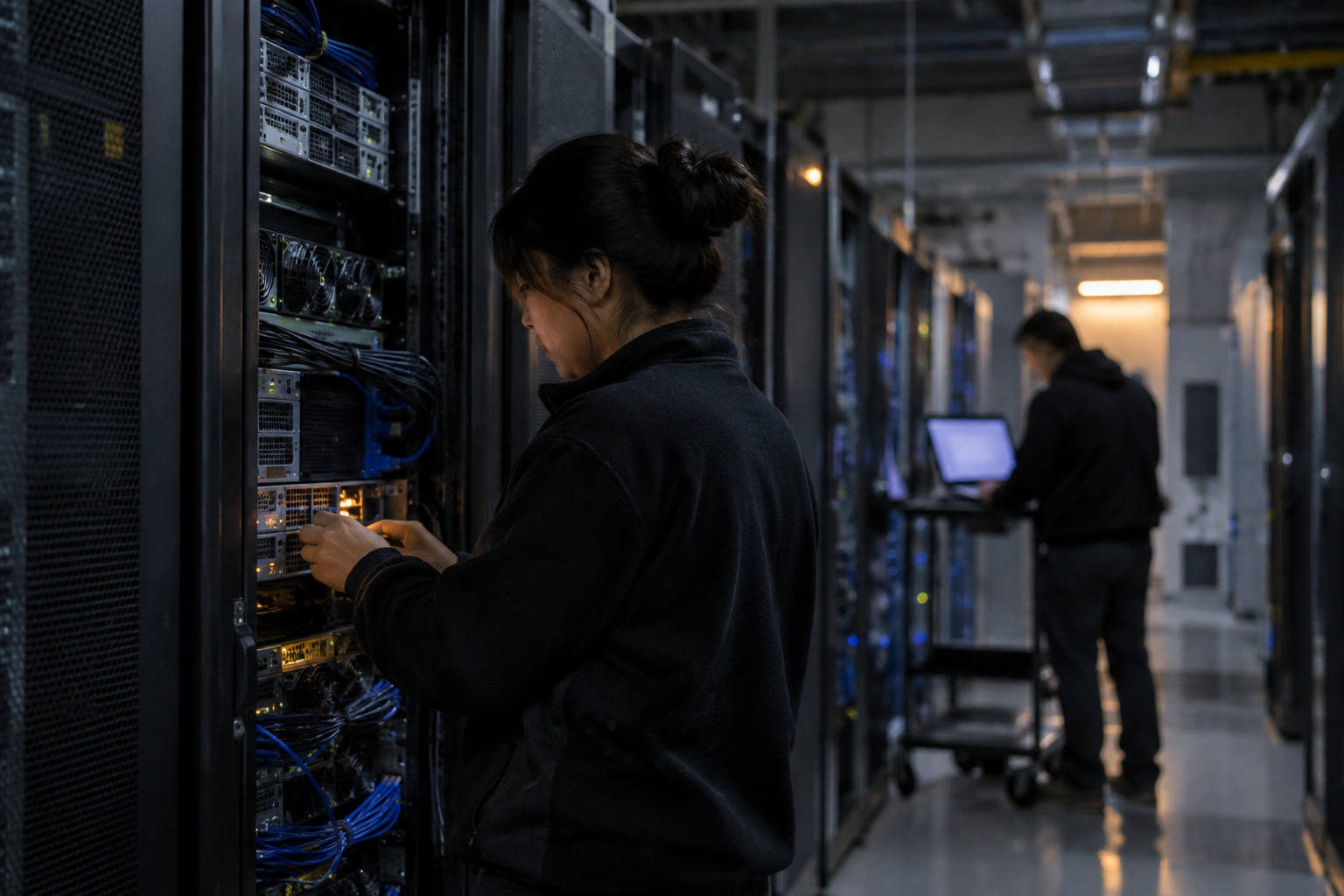
Deepgram decided paying the full Nvidia retail tax was no longer a viable business model. The speech-to-text heavyweight teamed up with Amazon Web Services to migrate model training and architectural optimization over to AWS Trainium silicon.
This is not a casual sandbox experiment. Deepgram makes its living converting spoken audio into structured text at speeds human brains interpret as instant. Doing that requires continuously training foundational audio models on hundreds of thousands of hours of conversational data. For years, that pipeline lived almost exclusively on Nvidia hardware. Now, Deepgram has plugged its model pipeline into AWS EC2 Trn1 instances, built explicitly around Amazon’s in-house silicon.
The technical payoff lands directly on training throughput. Trn1 instances feature up to 16 Trainium chips with 512 gigabytes of high-bandwidth memory. They pack 800 gigabits per second of Elastic Fabric Adapter networking bandwidth. Deepgram took advantage of those raw pipe specifications to compile and train their transformer-based speech architectures using the AWS Neuron software development kit.
By moving these model runs from standard enterprise GPUs to Amazon's purpose-built accelerators, Deepgram carved out immediate reductions in training expenses while holding the line on word error rates.
The economics of voice AI do not forgive vendor loyalty; you either control your compute costs or your margins vanish before your customer takes their second call.
This operational shift hits the voice AI sector where it actually hurts: compute margins. Running voice agents in production requires constant model iterations. Every dialect update, background noise filter, and domain-specific terminology pack requires another trip through the training cluster. Doing that on top-tier Nvidia clusters burns cash at terrifying speed. Deepgram's shift proves that alternative silicon can take the beating without dropping audio accuracy.
To understand why this move matters, look at how speech recognition used to work. A decade ago, automated transcription ran on legacy statistical toolkits like Kaldi. Engineers had to stitch acoustic models, language models, and pronunciation dictionaries together with digital duct tape. Deepgram took a sledgehammer to that framework by introducing an end-to-end deep learning architecture that processed raw audio directly into text.
That architectural bet worked, but it created an insatiable appetite for compute. Deep learning speech models require absurd amounts of floating-point arithmetic. When generative voice agents caught fire across enterprise tech in 2023, the demand for speech-to-text engines exploded. Voice agents do not have the luxury of waiting two seconds for a transcription pass. A conversational bot needs the transcript within 250 to 300 milliseconds, or the caller hangs up.
That operational reality drove every voice AI company into Nvidia’s waiting arms. Enterprise-grade H100 and A100 systems became the only game in town. Cloud providers jacked up rental rates, rationing compute like water in a drought. For startups and mid-sized voice platforms, cloud invoices began consuming entire venture rounds just to keep the training clusters warm.
AWS saw the vulnerability years ago. Amazon purchased Annapurna Labs back in 2015 for roughly $350 million. That single acquisition laid the foundation for Amazon’s silicon rebellion. Annapurna delivered the Nitro system, then the Graviton CPU line, then Inferentia for inference, and finally Trainium for heavy machine learning training workloads.
AWS launched Trainium to give cloud tenants an escape hatch from the CUDA walled garden. Yet many machine learning teams dragged their feet. Transitioning away from CUDA meant dealing with new compiler quirks, adjusting precision settings, and fighting immature developer tooling. Deepgram took the plunge anyway because the math left them no choice.
Here is how the platform hardware stacks up under the hood:
Deepgram framed the integration as a clean operational win. Their engineering leadership emphasized that speech models require continuous domain adaptation. Voice agents deployed in healthcare, finance, and industrial logistics require hyper-specific vocabularies. If retraining a medical transcription model costs a small fortune in compute, the vendor cannot ship daily updates to enterprise clients. By utilizing Trainium, Deepgram argues they can maintain continuous retraining schedules without passing absurd computing charges down to their end users.
AWS, naturally, treated the deployment as concrete validation of their chip design strategy. The hyperscaler has faced persistent skepticism from machine learning engineers who argue that nothing outside Nvidia's software ecosystem is ready for prime-time model development. Amazon points to Deepgram’s real-world throughput as evidence that the Neuron software stack has matured past the experimental stage.
Third-party engineers remain pragmatic. The developer consensus on independent forums highlights the real friction: porting models to Trainium is rarely a one-click affair. The Neuron compiler requires teams to restructure how they handle custom layers, non-standard loss functions, and low-level memory operations. Teams that lack Deepgram's deep bench of in-house machine learning scientists often stumble during the migration.
Still, enterprise buyers looking at invoice totals are siding with the bottom line. Voice agent providers cannot survive on thin software margins if sixty percent of their revenue routes directly to cloud graphics cards. Deepgram demonstrated the migration is possible; the industry is now calculating whether it can afford not to follow.
The immediate consequence of this rollout is pricing pressure across the voice market. When a major transcription vendor cuts its foundational training overhead, its competitors face an ugly dilemma. They can either stay on expensive GPU fleets and accept compressed margins, or they can invest months of engineering effort into alternative silicon compilers.
Expect this hardware transition to accelerate with the wider rollout of Trainium2. AWS already announced its second-generation Trainium hardware, claiming a 4x leap in training performance and up to a 3x boost in memory capacity over the original chips. When providers like Deepgram migrate to Trainium2 clusters, the cost per hour of trained speech models will fall another tier.
This trend will transform voice agent economics. Right now, running an autonomous phone agent costs between ten and twenty cents per minute across telephony, speech-to-text, large language models, and text-to-speech. Speech-to-text accounts for a sizable chunk of that per-minute toll. As custom silicon cuts Deepgram's internal infrastructure bills, developers should expect per-minute transcription pricing to drop significantly over the next eighteen months.
Nvidia will not sit on its hands. The chip giant is actively pushing smaller, faster architectures and software optimizations through TensorRT-LLM to defend its turf. But the damage is done. Deepgram proved that a tier-one voice company can run core production model training outside the CUDA ecosystem without wrecking accuracy or throughput. The hardware monopoly in voice AI is officially over.
Nvidia built a fortress around AI compute, and voice vendors have spent two years paying the toll. Deepgram proving out AWS Trainium at scale shows conversational AI companies do not have to swallow twenty-thousand-dollar GPU bills to ship fast speech models. When the compute toll drops, per-minute voice pricing drops with it. That breaks down the cost barriers holding back widespread, persistent voice agents across enterprise call desks.
Reported off Voice vendor watch. Original reporting and analysis by Marla Quinn for Vox Roboti.
Deepgram adopted Trainium to reduce speech model training costs, bypass Nvidia GPU allocation bottlenecks, and improve throughput for continuous model updates.
Trainium is a custom machine learning accelerator chip designed by Amazon Web Services through its Annapurna Labs acquisition for training deep learning models.
No. Most AI teams maintain hybrid fleets, using Trainium for optimized batch workloads and Nvidia chips where CUDA compatibility remains strictly mandatory.
Faster, cheaper training cycles allow Deepgram to ship tighter, specialized models that maintain real-time transcription speeds below 300 milliseconds.
Trainium relies on the AWS Neuron software development kit, which compiles PyTorch and TensorFlow models to execute on custom Amazon silicon.
Yes. Lower infrastructure and training overhead directly compresses per-minute transcription costs across developer-facing voice APIs.
Priya Raghunathan · 2d ago · 5 min read
Nina Falco · 3d ago · 5 min read

Devon Achebe · 4d ago · 4 min read