Voice Agents
Google Drops the Fitbit Edge and Tightens the Hardware Trap
Priya Raghunathan · 2d ago · 5 min read
Nvidia just turned open-source robotics into an instant holiday sellout after Jensen Huang commanded a flock of voice-driven Microducks across the GTC Berlin stage.

By Devon Achebe, Infrastructure reporter · Reported off TechCrunch AI
Follows latency, cost and the parts of the stack vendors hide.
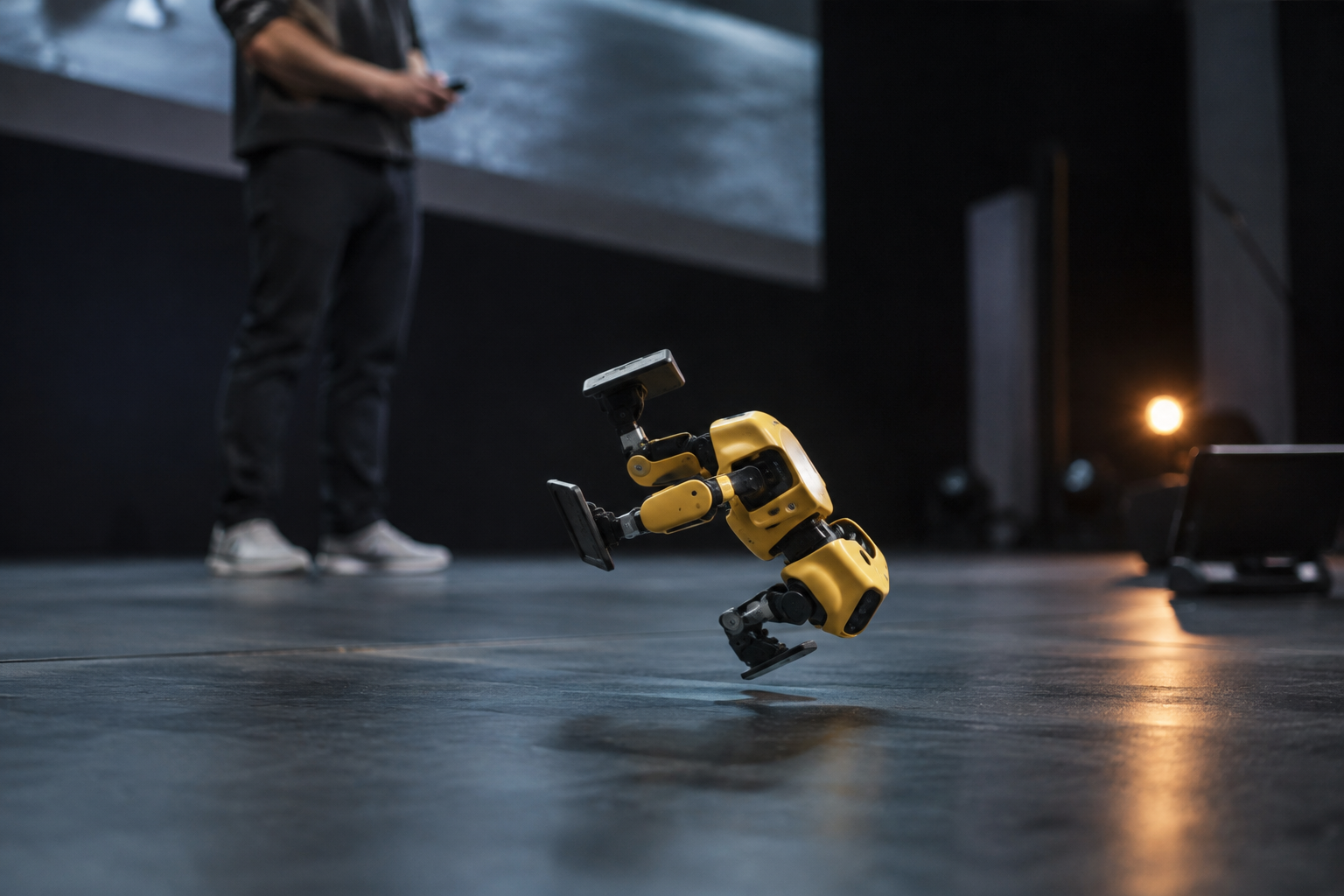
Jensen Huang walked onto the GTC Berlin stage, looked down at the floor, and started giving spoken orders to a pack of plastic birds.
The machines were Microducks. They waddled forward on mechanical feet, whistled synthesized R2-D2 chirps, flattened themselves onto the floor on vocal command to fake a nap, and threw themselves into forward somersaults when Huang told them to flip. The hardware did not stutter, miss an acoustic cue, or stall out on the carpet.
Within twenty-four hours of that keynote demonstration, buyers booked more than 20,000 preorders. Hugging Face chief executive Clem Delangue posted the milestone figure publicly the following morning, confirming that the initial run was already tracking to land on doorsteps before December 25.
Nvidia pushed the stage footage through its Nvidia RTX Spark channel, showing the bots translating direct voice commands into multi-joint physical movements. The product is not a static countertop cylinder with a speaker grill. It is a fully articulated, open-source biped that executes physical routines by linking speech models to physical motor controls.
The sales velocity moved faster than almost any consumer robotics launch in recent memory. For twenty-four hours, buyers bypassed standard retail channels to reserve an open-source hardware kit directly from an enterprise pipeline. The core mechanics on display included:
To understand why a Silicon Valley chip titan is suddenly shipping plastic ducklings, you have to trace a frantic eighteen-month paper trail of mergers and developer buyouts.
The hardware originated inside Pollen Robotics, the French engineering shop that built the Reachy Mini research platform. Pollen spent years building expressive open-source limbs for academic labs that had small budgets and zero interest in closed industrial patents. Hugging Face acquired Pollen in 2025 to anchor its physical robotics division, giving the open-source software hub a direct line into physical edge hardware.
Then the real consolidation hit. Nvidia acquired Hugging Face outright in September 2026. The purchase gave Huang total control over the world's most dominant developer ecosystem for open models, along with Pollen's entire physical hardware bench.
When you marry physics simulation to edge execution, the spoken prompt stops being an internet query and becomes a physical trigger.
The Microduck run is the first commercial fruit of that dual acquisition. The training pipeline did not happen on living room floors. Nvidia engineers modeled the ducks inside their RTX Spark simulation stack, running digital duplicates through millions of synthetic balance failures before ever cutting an injection mold. The software simulated joint friction, acoustic delays, and floor surface resistance in a digital world before exporting the final model parameters down to physical boards.
That sim-to-real training pipeline cut standard robotics prototyping schedules from three years down to mere months. Instead of hard-coding every step of a somersault with manual motor angles, developers taught the model to preserve balance inside virtual space, linked the sequence to a natural language audio trigger, and pushed the compiled package into consumer flash memory.
The retail reaction split cleanly between enterprise relief and developer amusement. The Berlin keynote arrived during one of the most punishing news cycles the cybersecurity sector had seen all year, following days of back-to-back corporate intrusions tied to generative code agents.
Delangue focused squarely on the weird demographic profile of the buyer base, pointing out across his social channels that the initial reservation pool is dominated by adults rather than parents buying holiday trinkets for children. His public assessment was blunt: the duck is currently positioned to become the highest-volume consumer robot delivered anywhere in 2026, regardless of user age.
Corporate commentators zeroed in on Huang's messaging pivot. After forty-eight hours of headlines detailing weaponized autonomous scripts and enterprise perimeter breaches, Nvidia swapped the narrative overnight by showing that local voice models can simply be used to make small yellow toys do gymnastics on command.
Hardware hackers pointed to the open-source firmware as the real story. Pollen built the duck's behavioral routines to be fully reprogrammable. Developers are already publishing plans to map the local speech receiver to custom toolchains, replacing the stock chirps with local large audio models and swapping out the canned somersault for custom mechanical choreography.
The immediate operational hurdle is physical assembly and freight delivery. Pollen and Nvidia face an unforgiving shipping window: 20,000 units must clear contract manufacturing, flash validation, packaging, and international freight inside of eight weeks to make good on Delangue's Christmas delivery guarantee.
Beyond holiday logistics, the launch exposes a permanent break from traditional voice hardware. For a decade, the voice sector convinced consumers that a smart interface meant a black hockey puck sitting silently on an end table waiting for weather requests. The Microduck represents an entirely different class of device: an interactive edge agent whose speech processing exists solely to alter physical space.
The broader hardware developer base will get access to the underlying movement library as soon as the first production batch clears delivery. Because Pollen's architecture remains open, owners will not be locked inside a walled proprietary app store. Users can teach their devices new physical routines in Nvidia's simulation environments, bind those physical motions to spoken phrases, and post the resulting model weights online for other owners to download.
Smart speakers taught a generation of consumers to ignore voice interfaces because stationary cylinders never did anything interesting after reporting tomorrow's forecast. Nvidia just proved that if you attach those same voice tokens to a biped that tumbles across a desk on command, consumers will clear out twenty thousand units before the stage lights even cool down.
Stationary smart speakers turned voice interfaces into boring kitchen appliances. By tethering speech models to physical motor control and open-source simulation tools, Nvidia just turned voice AI into an embodied toy market overnight. When natural language prompts command physical acrobatics instead of web searches, voice tech stops being an invisible utility and becomes an interactive consumer product with genuine commercial traction.
Reported off TechCrunch AI. Original reporting and analysis by Devon Achebe for Vox Roboti.
It is an open-source, bipedal robot built by Pollen Robotics that moves and somersaults using real-time voice commands.
Nvidia owns it, following its September 2026 acquisition of Hugging Face, which previously bought Pollen Robotics in 2025.
Buyers reserved over 20,000 units within 24 hours of Jensen Huang's GTC Berlin keynote presentation.
Engineers trained their motor skills inside Nvidia's RTX Spark simulation environment before deploying the models onto physical hardware.
Yes. Pollen designed the hardware as an open-source platform, allowing owners to train new actions and share model files.
Deliveries are scheduled to reach customers before Christmas 2026.
Priya Raghunathan · 2d ago · 5 min read
Nina Falco · 3d ago · 5 min read

Devon Achebe · 4d ago · 4 min read