Voice AI
Amazon Silently Kills Alexa Voice Switching for Older Echo AUX Jacks
Selma Ortiz · 15h ago · 4 min read
Anthropic launched Claude Duet, turning its reasoning engine into an autonomous desktop worker. The move takes direct aim at legacy RPA and voice-driven software control.

By Devon Achebe, Infrastructure reporter · Reported off Reuters AI watch
Follows latency, cost and the parts of the stack vendors hide.
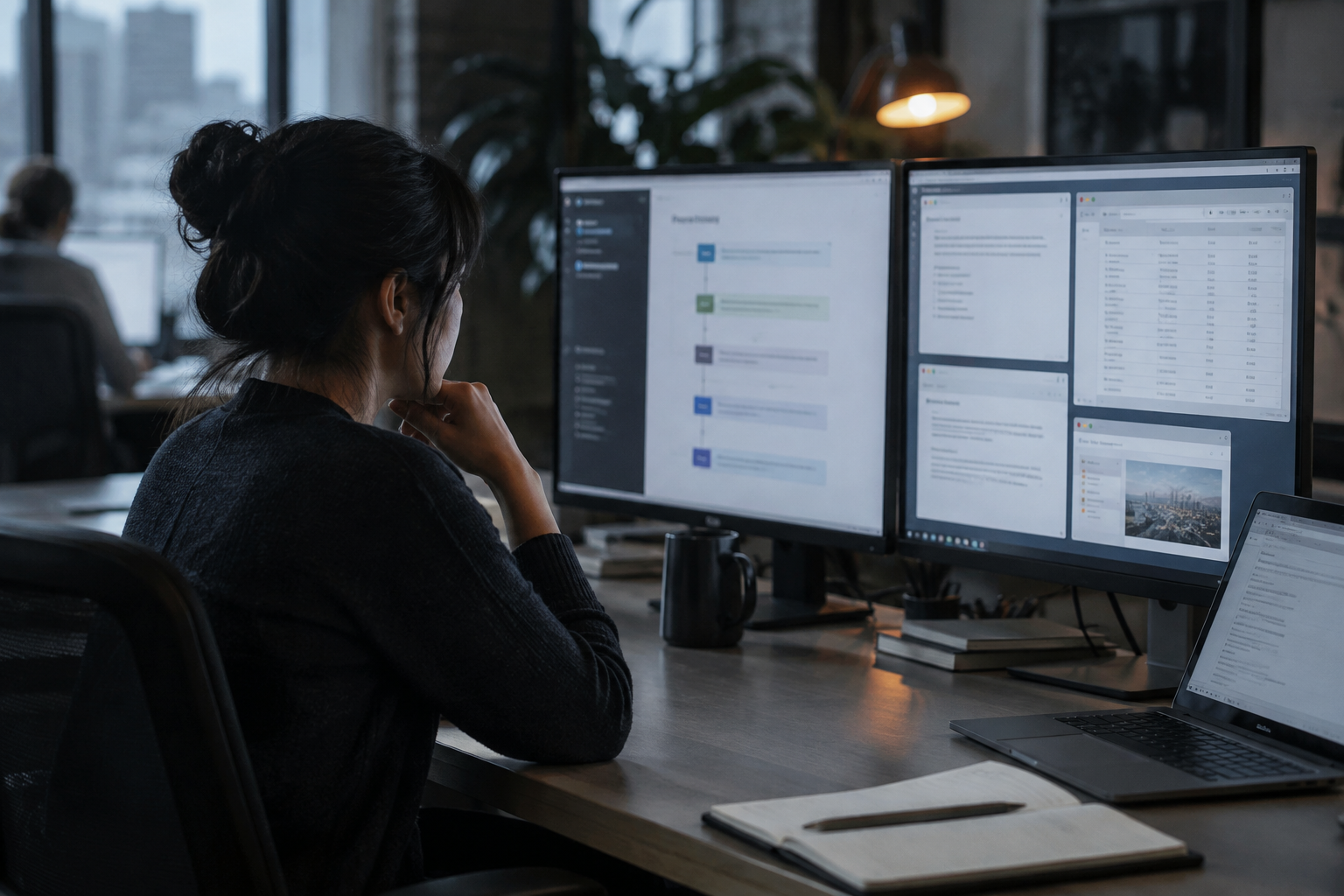
Anthropic decided chatting through a browser window was no longer enough. The company rolled out Claude Duet, a dedicated application designed to execute actions directly inside user environments rather than just handing back polished paragraphs.
This release strips away the theoretical sheen from autonomous software control. Claude Duet acts as an interactive co-worker on your machine. It takes voice directives, interprets onscreen workflows, and executes complex operational sequences across desktop applications without requiring users to write custom Python scaffolding.
Instead of asking you to copy and paste text between browser tabs, Duet pairs model cognition with local action execution. The interface combines conversational input, continuous status feedback, and a structured task queue. You speak an objective into your microphone, or type a multi-part command into the control drawer, and the agent breaks the goal into sequential subtasks.
From there, Duet navigates desktop software directly. It reads open windows, interacts with interface elements, fills form fields, retrieves files, and reports progress back to the user. Anthropic packaged the tool with explicit permission boundaries, forcing the system to pause and request human clearance before it touches sensitive records, initiates financial transfers, or sends outgoing messages to external contacts.
The initial rollout targets professional workflows where repetitive cross-software manual data entry consumes daily operating hours. That includes customer record synchronization, operational log audits, multi-platform asset management, and scheduled reporting. By turning Claude into an active desktop operator, Anthropic moved out of the passive advice business and entered the functional labor market.
To understand why Anthropic built Duet, you have to look at how Dario and Daniela Amodei built Anthropic. When the siblings walked away from OpenAI in 2021, they planted their flag on safety research and model steering. They introduced Constitutional AI to rein in model behavior, followed by the Claude 3 family—Haiku, Sonnet, and Opus—in early 2024.
By late 2024, the frontier model race ran into a wall of diminishing returns for simple text generation. Every major frontier lab had an LLM that could write clean email drafts and debug code snippets. The competitive frontier shifted toward agency: models that actually do things in the wild.
Anthropic made the first aggressive move in this direction in October 2024 when it released the Computer Use API in beta for Claude 3.5 Sonnet. That API gave developers the primitives to let Claude look at screenshots, move virtual cursors, click coordinates, and type text into native software. It was technically impressive, but it lived behind developer consoles and required Docker containers to run without breaking user machines.
Ordinary enterprise operators do not build Docker containers. They run spreadsheets, customer databases, internal portals, and legacy enterprise resource software. Meanwhile, the competition started crowding the door:
Raw developer APIs do not win enterprise software contracts. Packaged client applications do. Claude Duet represents the consumerized, enterprise-ready evolution of Anthropic's Computer Use experiment, wrapped in an interface that non-technical workers can command by voice or text.
Reaction across enterprise IT and developer circles divided immediately between operational optimism and security panic. Corporate tech executives understand the labor savings of autonomous agents, but granting a statistical model direct access to local software gives security chiefs cold sweats.
System administrators pointed out that autonomous desktop agents introduce an entirely new threat surface: indirect prompt injection. If Claude Duet parses an untrusted document or opens a hostile web page containing hidden instructions, the agent could theoretically follow those adversarial prompts and leak proprietary files. Anthropic addressed this by establishing strict runtime permission walls, but corporate security teams remain cautious about giving any AI software unfettered access to internal tools.
"Giving a reasoning model cursor control saves three hours of manual entry, but it turns every unvetted document into an execution risk."
Voice automation proponents see Duet as the missing bridge for hands-free computing. For decades, voice control meant rigid voice commands like "open calendar" or "set timer." Voice-driven agents backed by frontier models allow natural, messy spoken requests to trigger end-to-end multi-app workflows. Instead of clicking through twelve software menus, a manager speaks a goal and watches the software do the heavy lifting.
At the same time, software developers running early benchmarks highlighted the economic realities of agentic workflows. Autonomous task execution consumes enormous amounts of compute. When an agent captures desktop screenshots every three seconds, runs vision reasoning on each frame, and recalculates its next click, the token bills mount rapidly. The financial math only works if the labor hours saved far outweigh the API inference spend.
Anthropic now has to prove Claude Duet can survive the messy reality of production software. Corporate software environments are rarely clean. Enterprise tools update without warning, pop-up dialogs appear unpredictably, network connections stall, and user permissions break across internal networks. An agent app that stumbles when a software update shifts a button three pixels to the left will get uninstalled fast.
The primary commercial casualty of this rollout is legacy Robotic Process Automation. Legacy RPA platforms like UiPath and Automation Anywhere built massive businesses on rigid, brittle scripts that break the moment an underlying web page alters its DOM structure. Anthropic's vision-driven agent does not care about DOM trees. It sees the screen like a human worker, adapts to visual changes, and reasons through interface updates on the fly.
The real test will be execution speed and latency reduction. Right now, running multi-modal reasoning across desktop screenshots creates a noticeable lag between command and execution. For voice-first workflows, that latency is jarring. Users expect responsive action, not awkward pauses while a server farm calculates screen coordinates.
Anthropic's roadmap will focus on local optimization, faster reasoning loops, and deeper native hooks into foundational enterprise platforms including Salesforce, GitHub, Slack, and Google Workspace. The race is no longer about who builds the smartest conversationalist. The race belongs to whoever turns that intelligence into a reliable, low-cost worker that never botches the paperwork.
The software market just shifted from passive answer engines to active functional labor. Anthropic is betting that business buyers do not care about chatbot eloquence anymore; they care about offloading repetitive keyboard work. By wrapping autonomous screen execution in a voice-ready interface, Claude Duet turns software from a manual tool into an automated operator. The labs that master this transition will dominate enterprise computing for the next decade.
Reported off Reuters AI watch. Original reporting and analysis by Devon Achebe for Vox Roboti.
It is an autonomous agent application built by Anthropic that performs complex tasks across desktop software.
Users guide the application using spoken voice directives or typed task sequences inside a desktop control drawer.
No. Duet packages Anthropic's agent technology into an end-user client that works without custom development code.
The application pauses and requests explicit user confirmation before executing sensitive operations or sharing private data.
It captures screen images, visually analyzes open software windows, and performs mouse clicks and keystrokes automatically.
It competes against legacy RPA platforms like UiPath, alongside AI agent tools from OpenAI and Google.
Selma Ortiz · 15h ago · 4 min read
Cass Iverson · 2d ago · 5 min read
Selma Ortiz · 2d ago · 5 min read