Voice AISep 17, 2026 · 5 min read
Treble Scores $18 Million to Stop Voice AI From Choking on Room Noise
Icelandic startup Treble just pulled in an $18 million Series A extension to replace garbage scraped audio with synthetic sound physics for Amazon and Logitech.

By Selma Ortiz, Product and labs writer · Reported off TechCrunch AI
Tests every model on ugly, real calls. Writes reviews vendors dread.
The key facts
- Treble raised an $18 million Series A extension led by Paladin Capital Group.
- Cumulative funding for the Icelandic startup now exceeds $40 million.
- Co-founders Finnur Pind and Jesper Pedersen established the company in 2020.
- Current enterprise customers include hardware giants Amazon and Logitech.
- Treble partnered with Hugging Face earlier this year on speech recognition benchmarks.
What happened
Most voice models fall apart the second an air conditioner kicks on or a coffee mug clatters onto a glass desk. Treble just grabbed an $18 million Series A extension to solve that exact headache with pure acoustic physics.
Paladin Capital Group led the round, writing the primary check. Existing backers KOMPAS VC, Frumtak Ventures, the European Innovation Council (EIC), and Omega ehf followed along without hesitation.
This fresh capital injection pushes Treble's total war chest past the $40 million mark. That number includes a $12 million capital tranche secured in 2024, demonstrating steady institutional appetite for non-glamorous acoustic engineering.
Co-founders Finnur Pind and Jesper Pedersen launched the outfit out of Iceland in 2020. Both men cut their teeth as acoustic engineers before realizing software developers were building sophisticated speech models on top of pathetic audio data.
The capital is already backed by enterprise production contracts. Enterprise heavyweights Amazon and Logitech currently pay Treble to run acoustic simulations on their proprietary hardware and conversational software suites.
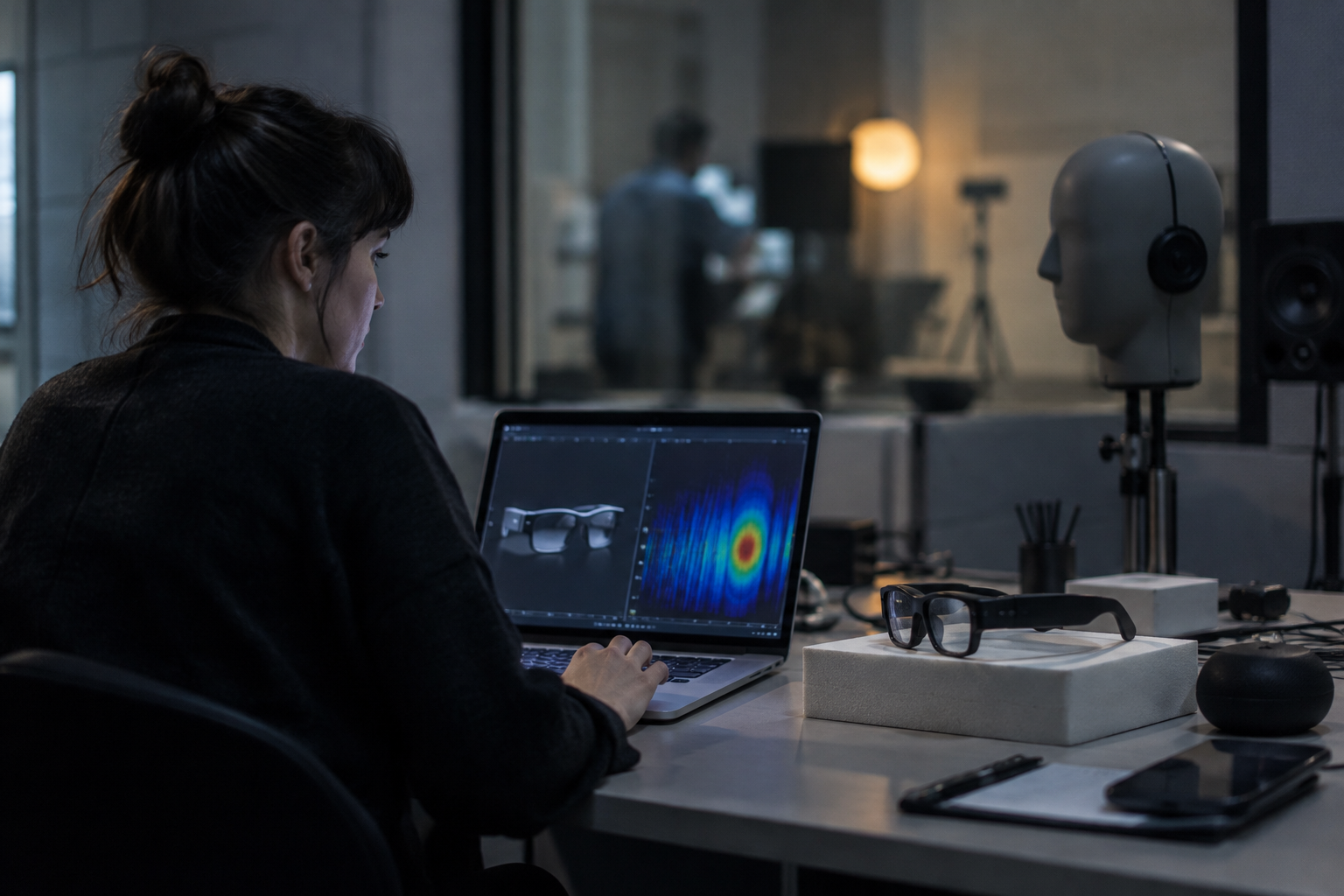
Instead of renting anechoic chambers or driving test vans through rainy intersections, these hardware makers run cloud-based spatial audio simulations. They stress-test how microphones grab signals when someone shouts from across a tiled kitchen.
Treble splits its commercial platform into two practical utility engines:
- Synthetic audio generation designed to train models against customized noise profiles, speech enhancement routines, and background cancellation algorithms.
- Virtual acoustic benchmarking that models sound bounce, room reverberation, and microphone array placement inside hardware enclosures.
This platform eliminates physical mockups. Consumer electronics teams no longer spend three months building plastic shells just to discover their directional microphone array picks up the internal cooling fan instead of the user.
The background
Voice AI spent the last three years drowning in venture checks. Billions went into customer support automation agents, enterprise meeting transcription services, and multimodal hardware experiments like smart glasses.
Yet every foundation model shares the same dirty secret: they were trained on scrapings from YouTube videos, podcast archives, and digitized phone recordings. That audio data is dirty, compressed, and acoustically flat.
When developers deploy those models into actual hardware, performance craters. A transcription model trained on clean podcaster voices through Shure SM7B microphones drops syllables when deployed through an earbud microphone on a windy street.
Earlier this year, Treble teamed up with open-source machine learning hub Hugging Face to launch a public speech recognition benchmark. The project systematically exposed how state-of-the-art transcription models degrade when exposed to real-world room reflections.
Engineers call this the cocktail party problem. Humans can isolate one speaker in a crowded dining room with two ears and a biological neural network, while a $500 smart display gets confused by an open window.
Hardware design cycles make this software problem significantly worse. Traditional audio tuning requires an acoustic engineer to sit in an isolated chamber with physical speaker prototypes, measuring frequency responses inch by inch with calibrated reference gear.
Pind and Pedersen spent their early research years modeling wave equations to automate that manual ritual. They turned wave-based sound field simulation into a compute problem that renders sound propagation through complex indoor geometries.
Smart speaker manufacturers use this engine to test beamforming algorithms before cutting tooling dies. If a speaker sits adjacent to a plaster wall or tucked inside a bookshelf, Treble calculates the acoustic reflection path instantly.
What people are saying
Treble chief executive Finnur Pind argues the entire machine learning industry made a foundational mistake by treating voice processing as a simple web-scraping exercise.
"Audio AI is really a data challenge, and this is where the most opportunities to enable next-generation models and hardware lie. To date, pretty much all sound-related AI has been made from recordings and data scraped from the internet. We believe that accurate physics simulation can be an alternative way to create data for sound."
Pind contends that without physics-based synthetic data, speech models cannot bridge the gap to industrial reliability. Scraped audio cannot teach a model how sound waves scatter against concrete walls or bend around human skulls.
The co-founder is explicitly targeting hardware form factors that demand real-time audio isolation, specifically the emerging category of AI-enabled smart frames.
"I'm really excited about the next generation of these devices like headphones and smart glasses that can enable [a feature like] superhuman hearing. That's an area where you can really just hear better in challenging acoustic environments. Maybe you are in a restaurant, and you only want to hear people within two meters of range, or you are in a seminar, and want to mute people around you."
From the investor side, Paladin Capital Group framed this investment as defensive infrastructure for the entire hardware ecosystem. Vice president Francois Ruether claims physical acoustic modeling will separate deployable edge agents from brittle research demos.
"Our thesis is that, as more products depend on understanding sound, this infrastructure becomes increasingly valuable across voice AI, wearables, robotics, and physical AI. Customers retain ownership of their models, products, and development workflows, while benefiting from a shared foundation of a simulation-native acoustic infrastructure layer."
Ruether points out that enterprise clients refuse to surrender their proprietary model architectures to third parties. By delivering synthetic training data and benchmark curves without touching model weights, Treble sidesteps enterprise intellectual property disputes.
What happens next
Treble is already allocating this fresh capital toward a concrete sector expansion: physical artificial intelligence. That roadmap covers autonomous robotics, commercial drones, and automotive passenger cabins.
Automated delivery drones need acoustic telemetry to detect approaching aircraft and diagnose motor bearing failures before catastrophic dropouts occur. Treble is configuring its simulation engine to model rotor wash and propeller turbulence in variable wind conditions.
Automotive engineering teams are testing the platform to simulate how voice agents register driver commands while windshield wipers scrape and highway rain slams the wheel wells. Road noise remains the primary killer of automotive voice commands.
The robotics vertical represents an even tougher acoustic frontier. Warehouse robots must distinguish between an emergency verbal halt command from a human floor worker and the ambient metallic clatter of nearby forklift tines.
Consumer electronics firms will lean harder into this synthetic pipeline to bypass European Union and American data privacy restrictions. Training models on physically modeled waveforms bypasses the legal minefields associated with harvesting private human conversations from the open internet.
If Treble executes on this roadmap, acoustic engineers will no longer spend six-figure budgets flying technicians across the globe to record ambient background noise in hotel lobbies and subway stations. They will dial up a software dashboard, enter the room dimensions, specify the wall materials, and generate a million synthetic audio samples in minutes.
How we got here
- 2020Acoustic engineers Finnur Pind and Jesper Pedersen launch Treble in Iceland.
- 2024Treble closes a $12 million funding tranche to expand audio simulation.
- Early 2026Startup partners with Hugging Face to launch speech recognition benchmarks.
- 16 Sep 2026Treble announces an $18 million Series A extension led by Paladin Capital Group.
The short version
- Treble secured an $18 million Series A extension led by Paladin Capital Group.
- Total capital raised by the Icelandic acoustic simulation company now exceeds $40 million.
- Amazon and Logitech use the platform to simulate device audio and train speech models.
- Treble generates physics-based synthetic audio data to replace flawed web-scraped training datasets.
- The startup is expanding its acoustic simulation engines into robotics, drones, and smart glasses.
Why this matters
The voice AI boom hit a brick wall called physical reality. Software teams spent billions training massive speech models on clean internet MP3s, only to watch them choke the second a customer uses them on a breezy sidewalk or inside a reverberant kitchen. Treble is treating audio like an engineering problem instead of an ambient software hallucination. By replacing messy scraped recordings with mathematically accurate sound wave physics, they are handing hardware manufacturers the testing pipeline needed to make wearables, smart home gear, and industrial robots actually hear what you say.
Reported off TechCrunch AI. Original reporting and analysis by Selma Ortiz for Vox Roboti.
Questions people are asking
What does Treble actually do?
Treble builds acoustic simulation software. It generates synthetic sound data and tests how microphones, models, and smart devices perform in realistic, noisy physical rooms.
How much money has Treble raised to date?
Treble has raised over $40 million, including an $18 million Series A extension in 2026 and a $12 million round in 2024.
Who led Treble's $18 million funding round?
Paladin Capital Group led the round, with participation from KOMPAS VC, Frumtak Ventures, the European Innovation Council, and Omega ehf.
Which tech companies use Treble's audio platform?
Amazon and Logitech currently use Treble to simulate product acoustics, test microphone performance, and tune their voice devices.
Why is synthetic acoustic data better than scraped audio?
Scraped audio is compressed and dirty. Physics-based synthetic data precisely models wave reflections, spatial audio bounce, and harsh background noise without copyright or privacy issues.
What consumer hardware products is Treble targeting next?
Treble is designing acoustic simulations for smart glasses, noise-canceling headphones, and audio wearables to give users selective hearing in loud environments.
How does Treble work with robotics and drones?
Treble simulates mechanical noise like drone rotors and factory machinery, helping robotic voice systems hear voice commands through extreme acoustic interference.
More on Voice AI
Voice AI
Apple Rebrands AI, Resuscitates Siri, and Outsources Its Thinking to OpenAI
Ray Dalton · draft · 5 min read

Voice AI
OpenAI's Realtime Voice Update Just Wiped Out The Wrapper Startups
Nina Falco · 8h ago · 5 min read