Voice AI
Amazon Silently Kills Alexa Voice Switching for Older Echo AUX Jacks
Selma Ortiz · 15h ago · 4 min read
Google's smart speakers are silently burning through hundreds of gigabytes of home bandwidth due to broken firmware install loops, blindsiding users on capped internet connections.

By Ray Dalton, Editor-in-chief · Reported off The Verge
Runs the desk. Allergic to demos that only work on stage.
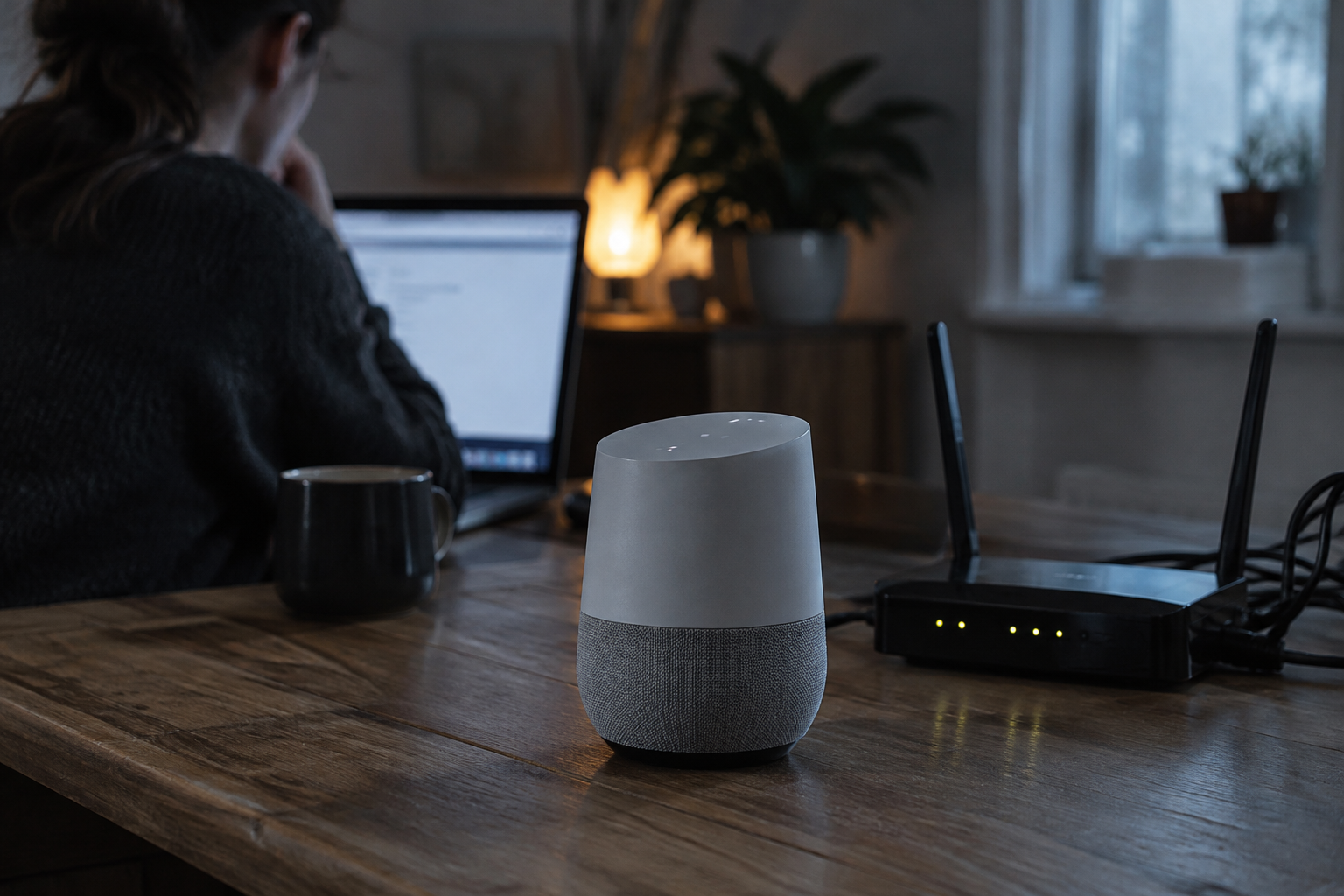
Your smart speaker sits on your kitchen counter, silent as a paperweight, waiting for you to ask about the weather. Meanwhile, behind that fabric grille, it is quietly burning through your home internet connection like a compromised torrent box.
Over the third week of October 2026, owners of Google Home hardware began noticing unexplained network congestion. Router logs revealed an ugly reality. Units were pulling down hundreds of gigabytes of phantom traffic directly from Google's servers without any user intervention or audio playback.
The culprit is an infinite retry loop tied to device maintenance. The speaker attempts to pull an over-the-air firmware update, runs into a corruption or installation failure midway through the package, discards the payload, and instantly tries again. It repeats this cycle dozens of times an hour, twenty-four hours a day.
For one Reddit owner, the tally exceeded 200 gigabytes consumed in a single 24-hour window. Another tracked unit ate 132 gigabytes across a month. Under normal circumstances, a voice assistant doing everyday tasks like streaming morning alarms and processing voice commands uses approximately 2 gigabytes in that same thirty-day span.
The hardware doing the damage is primarily Google's new Google Home Speaker model. The unit does not reboot with an error chime, flash a warning light, or alert your phone. It just hammers the download server until your local network chokes.
Silent over-the-air updating is the foundational compact of modern consumer tech. You buy an appliance with zero screen, zero diagnostic readout, and zero manual controls. In exchange, the vendor promises to maintain the software invisibly while you sleep.
When that compact holds, it works fine. When it breaks, you get invisible infrastructure damage. Most domestic internet subscribers in North America still operate under strict data caps, typically set between 1 and 1.2 terabytes per billing cycle. Cross that threshold, and broadband providers automatically slap penalty charges of $10 to $50 onto the monthly invoice.
Here is how that penalty math plays out when an unmonitored speaker goes rogue:
Because smart speakers lack visual displays, the end user has zero diagnostic surface. You cannot glance across the living room and see a network activity light flickering. Unless you are an enthusiast running a router with deep packet inspection or per-client bandwidth monitoring, the only notice you get arrives as a broadband invoice at the end of the billing cycle.
The device fails silently, discards the bad package, and instantly restarts the download loop, turning your broadband bill into collateral damage.
This is not the first time automated patch architecture has misbehaved in connected hardware, but the scale of this loop is uniquely aggressive. A full smart speaker operating system image rarely exceeds two or three gigabytes. Burning through 132GB means the speaker downloaded that complete image dozens of times, failing at the installation stage each time without backing off.
The pattern first surfaced across Reddit forums, where network hobbyists began posting screenshots of their router interfaces. Multiple users noticed their overall bandwidth usage spiking into the stratosphere during hours when their households were asleep.
Tech publication 9to5Google investigated the claims and verified the anomalous traffic patterns across independent hardware. Their monitoring confirmed that while an unaffected device logged a negligible 2GB over a month, an affected unit on the same platform clocked 132GB over the identical window.
Not every household is seeing the burn. The Verge's Tom Warren audited his own Google Home unit and found normal traffic patterns, indicating that the failure hinges on a specific hardware revision, network environment, or regional update server roll.
When confronted with the network logs, Google acknowledged the flaw directly. In an official statement delivered to 9to5Google, the search giant conceded the issue:
"A fix is already rolling out that should address this for users."
Jess Weatherbed at The Verge pressed the company for technical specifics regarding root cause and affected unit tallies, but Google declined to outline which hardware batches carry the bug or why the update client lacked basic exponential backoff protocols.
Google is pushing a server-side patch to kill the loop. For units that can successfully receive the incoming instruction, the constant downloading should halt without manual intervention.
If your speaker is caught in an unrecoverable crash cycle, waiting on Google's cloud fix may not be enough. If the speaker cannot successfully finish an update transaction, it might not process the patch designed to stop it from updating. The only immediate workaround for users on metered connections is brutal: unplug the device from wall power until Google confirms the deployment is complete across all regional distribution points.
Users concerned about their current billing cycle should log into their ISP portal immediately. Check your cumulative data consumption for October 2026. If you find a massive, unexplained spike, check your router's administrative client list to confirm whether the MAC address belonging to your Google Home hardware is responsible.
Broadband providers do not automatically waive overage fees because an appliance maker pushed bad code. If your household tripped an overage tier due to this loop, you will need to document the device logs and request a billing courtesy credit from your internet provider before the charge hardens on your statement.
For the voice AI industry, this bug highlights an embarrassing lapse in basic engineering hygiene. Any connected device deploying automated background downloads requires an exponential backoff routine. If an install fails once, it waits an hour. If it fails twice, it waits a day and pings the user. Setting a voice assistant to infinitely redownload a multi-gigabyte file until it devours 200GB in twenty-four hours is gross negligence in client software design.
When voice assistants live on dumb hardware without screens, silent software failures become financial liabilities. Shipping consumer hardware without basic backoff protocols turns an ordinary update glitch into an ISP penalty nightmare. If smart home vendors want ambient hardware running our lives, their software must respect local infrastructure limits instead of blindly devouring domestic bandwidth.
Reported off The Verge. Original reporting and analysis by Ray Dalton for Vox Roboti.
A bug in the firmware update process causes the speaker to endlessly download an update it cannot install properly.
Impacted devices have downloaded between 132GB over a month and more than 200GB in a single day.
An unaffected speaker consumes roughly 2GB of background data over an entire month under standard household conditions.
Reports are tied primarily to the new Google Home Speaker model, though not all devices are affected.
Google stated that a software fix is rolling out to resolve the infinite update loop for impacted devices.
If your device is stuck in the loop, disconnect it from power until Google's software fix reaches your hardware.
Selma Ortiz · 15h ago · 4 min read

Cass Iverson · 2d ago · 5 min read
Selma Ortiz · 2d ago · 5 min read