Voice AI
Amazon Silently Kills Alexa Voice Switching for Older Echo AUX Jacks
Selma Ortiz · 16h ago · 4 min read
Amazon buried fifteen years of Fire OS, launched three aluminum Alexa Tablets, and handed Google Play the keys to its budget hardware kingdom.

By Selma Ortiz, Product and labs writer · Reported off Ars Technica
Tests every model on ugly, real calls. Writes reviews vendors dread.
Amazon just burned fifteen years of hardware branding to sell you a certified Google device that whispers retail links in your ear.
On October 8, 2026, the retail behemoth scrapped the Fire label entirely. In its place sits a trio of aluminum slabs branded as Alexa Tablets. They do not run the old, quarantined Fire OS. They run full-fat, certified Android, complete with the Google Play Store preinstalled. Preorders opened immediately, with the hardware scheduled to ship to buyers on October 14.
The lineup starts at the low end with the Alexa Tablet 8 at $230. Next sits the Alexa Tablet 11 for $330. Both machines drop the old plastic shells for unibody aluminum chassis, pack MediaTek 8189 processors, and use 16:10 aspect ratio screens targeted squarely at streaming video.
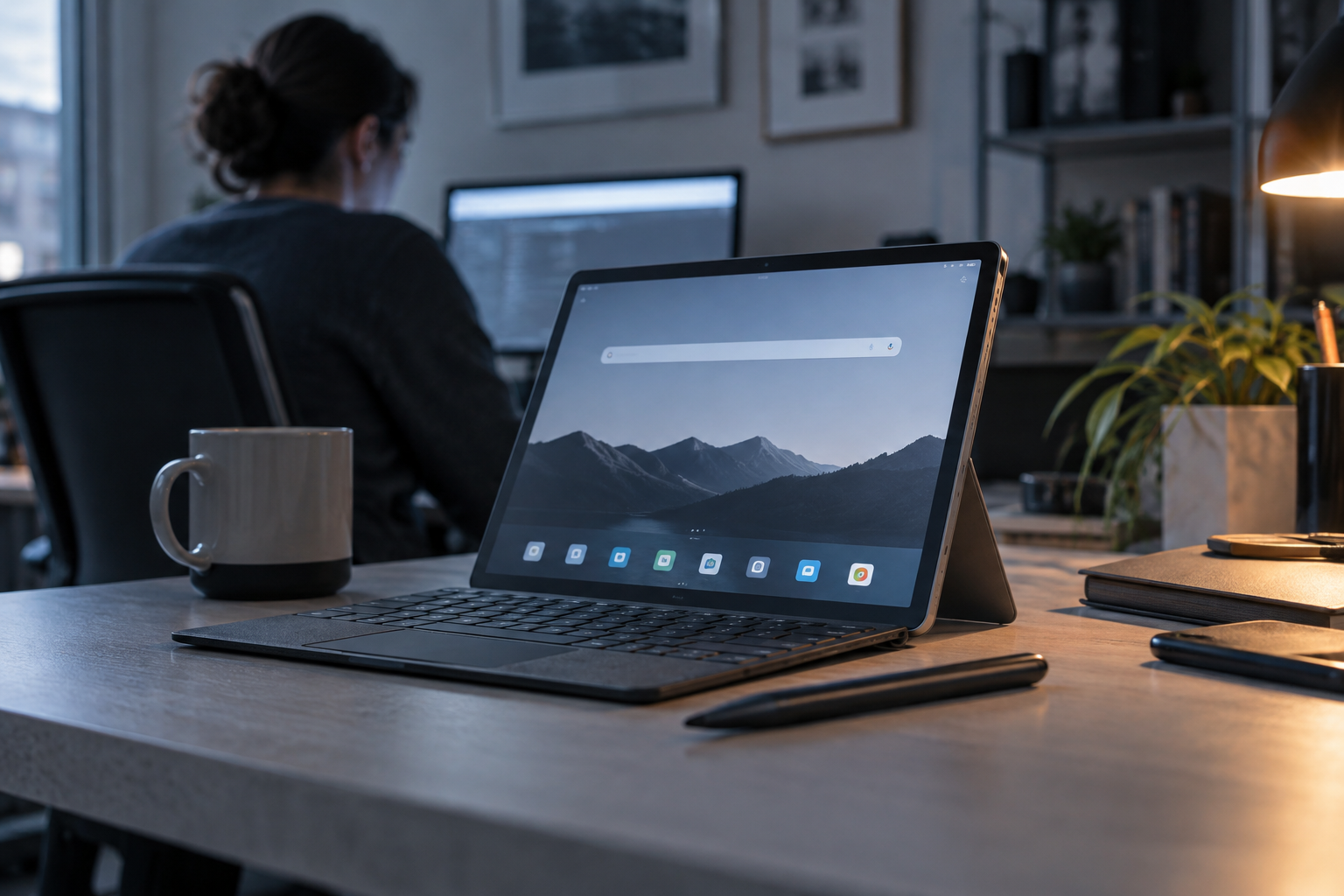
The marquee push sits at the top with the Alexa Tablet 12 Pro, priced at $500. This unit swaps the chassis geometry for a squarer 3:2 aspect ratio, designed for split-screen productivity rather than mindless couch scrolling. It runs a MediaTek Dimensity 8400 processor paired with 8GB of RAM and 128GB of internal storage. The glass stretches across a 2800×1840 panel running at a 120Hz refresh rate and topping out at 500 nits of peak brightness.
Amazon also built out a modular accessory tax for the 12 Pro. You can hand over $50 for a factory matte display coating, $150 for an attachable keyboard, and $90 for an active stylus. That pushes a kitted-out Pro past $790 before local sales tax enters the equation.
For a decade and a half, Amazon tried to pretend Google did not exist. The original Kindle Fire arrived in late 2011 running a lobotomized fork of Android. Amazon deliberately stripped out Google Mobile Services, built a walled garden, and attempted to coerce developers into submitting code to the Amazon Appstore. Users spent years sideloading Google APKs using sketchy desktop scripts just to install YouTube or Chrome.
The Appstore experiment died quietly last year when Amazon finally turned off the lights on its third-party app marketplace.
Maintaining a fork requires massive engineering overhead, and Amazon could no longer justify the bill. The software pivot created an awkward split inside the company's hardware division. Amazon shoved its streaming sticks onto Vega OS, an in-house Linux platform engineered to cut operating system royalties on television sets. But on slates, building an isolated mobile OS without an app ecosystem is commercial suicide.
By bending the knee to Google's licensing requirements, Amazon secured instant access to millions of Play Store titles without having to bribe developers to port their software. The trade-off is philosophical surrender. Amazon built its hardware empire on controlling the digital storefront. Now, Sundar Pichai collects transaction fees on Amazon's own hardware.
Hardware analysts see this move as a blunt economic recalibration against Apple's pricing floor.
At $230 and $330, Amazon undercuts Apple's baseline tablet while offering legitimate Google software instead of a janky fork. Yet industry observers point out an old problem that certification does not fix: Android tablet apps are notoriously unpolished. Google has spent five years begging developers to build dedicated tablet layouts, but most Android software still stretches awkwardly across large screens like blown-up smartphone interfaces.
The voice software strategy raises even more eyebrows across the tech desk. The hardware comes loaded with Google Play, which means owners can install Gemini, ChatGPT, or Claude with a single tap. Yet Amazon made Alexa Plus the native core of the hardware. Alexa answers to its standard wake word, tracks context across the active screen, and answers system queries. It also steers questions straight toward Amazon product listings whenever a purchasing angle exists.
Critics view the arrangement as an odd compromise. Amazon provides the aluminum and the commerce engine, while Google provides the operating plumbing and the app revenue pipeline.
The immediate battleground will be conversion rates. Fire tablets spent fifteen years as loss-leading holiday doorbusters tossed to toddlers. The Alexa Tablet lineup costs significantly more money. A family that casually bought a $50 Fire HD 8 during Prime Day will balk at spending $230 for the new baseline entry.
Amazon believes Alexa Plus provides the leverage to justify those higher margins. The on-screen context awareness allows the voice assistant to examine whatever document, flight booking, or video you are looking at and interject with relevant actions. If you look at camping gear, Alexa suggests compatible gear stocked in a fulfillment center twenty miles away. Amazon is betting that a high-end personal assistant tied directly to a warehouse logistics network turns a media slate into an active checkout counter.
The retail giant is also leaning on its home page real estate. When shipping starts on October 14, Amazon will plaster the Alexa Tablet family across every search result on its marketplace. That promotional lever alone guarantees millions of units will move into households before the fourth quarter closes, making Amazon one of the largest Android slate distributors on the planet overnight.
The real test arrives when Google and Amazon inevitably clash over default AI routing. Google wants Gemini handling system intelligence on certified Android hardware. Amazon wants Alexa Plus capturing the commerce data. For now, they share the glass. That fragile truce will last only until one assistant tries to lock the other out of the microphone.
Amazon surrendered its software isolationism because voice commerce cannot survive without competent apps. By conceding the operating system to Google, Amazon abandons the fantasy of owning the mobile OS layer and focuses on the real prize: embedding Alexa Plus as the commercial checkout clerk on premium hardware. If an AI assistant can see your screen, run your apps, and charge your Prime card without friction, the underlying platform vendor ceases to matter.
Reported off Ars Technica. Original reporting and analysis by Selma Ortiz for Vox Roboti.
Yes. Amazon dropped Fire OS and certified these devices with Google, giving them native access to the Google Play Store.
The Alexa Tablet 12 Pro base model starts at $500 with 128GB of storage and 8GB of RAM.
Yes. Because the tablets run standard Android, you can install Gemini or any other AI app from the Play Store.
Alexa Plus serves as the primary system assistant, supporting hands-free wake words and on-screen context comprehension.
Both the Alexa Tablet 8 and Alexa Tablet 11 run on the budget MediaTek 8189 processor.
The hardware is available for preorder now and begins shipping to customers on October 14, 2026.
Selma Ortiz · 16h ago · 4 min read

Cass Iverson · 2d ago · 5 min read

Selma Ortiz · 2d ago · 5 min read