Voice AI
Amazon Silently Kills Alexa Voice Switching for Older Echo AUX Jacks
Selma Ortiz · 16h ago · 4 min read
Meta smart glasses and voice apps let a visually impaired Cheshire farmer read cards, check pub menus, and inspect livestock without a sighted guide.
By Cass Iverson, Synthetic voice correspondent · Reported off BBC AI
Audio engineer turned reporter. Hears the artefacts you do not.
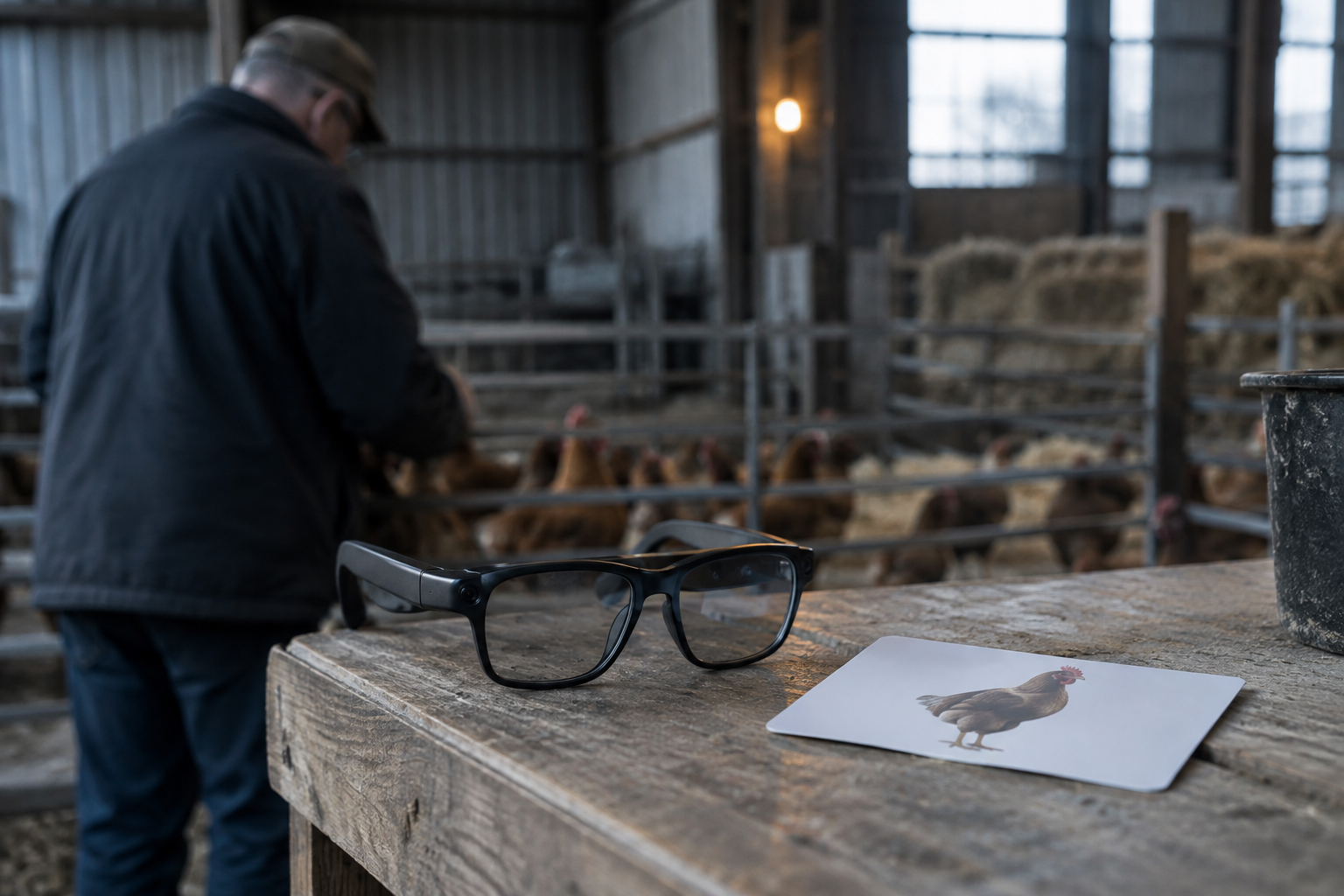
Dave Cragg runs a poultry breeding outfit in Wybunbury, Cheshire. He is sixty-five years old, and he has spent the last fifty-five years watching his eyesight vanish due to rod-cone dystrophy, an incurable condition that kills off retinal cells until only tiny fragments of peripheral sight remain. For his sixty-fifth birthday, Cragg bought hardware that most tech commentators treat as an irritating surveillance gimmick: a pair of Meta smart glasses equipped with front-facing camera sensors, open-ear audio speakers, and a wireless tether to his mobile phone.
His eldest daughter, Philippa Wilcox, is thirty-three. For her entire life, she had never witnessed her father read printed text unassisted. When the frames processed the text on his birthday card and spoke the written lines directly into his ears, that three-decade streak broke on the spot. The hardware package Cragg picked up turns ordinary ambient text into an immediate speech stream, letting him process printed mail, inspect farm equipment, decipher local pub menus, and navigate agricultural acreage without relying on a full-time human spotter.
The setup relies on two distinct software layers routed through the frame hardware. The first layer uses multimodal software to convert captured imagery into real-time speech summaries. The second layer ties the camera feed into Be My Eyes, a specialized visual assistance service. Instead of forcing Cragg to hold an awkward smartphone handset in front of his face while wrangling poultry, the optical sensors sit on his bridge, beaming his line of sight straight to live remote volunteers who feed spoken directional cues into his ears.
Rod-cone dystrophy strikes early and destroys sight progressively. Cragg began losing his vision at age ten. By the time a patient hits sixty-five with this disease, useful central vision is almost entirely gone, leaving only ragged edges of peripheral sensitivity that make reading, locating dropped tools, or tracking livestock impossible without physical intervention. In routine agricultural work, that level of visual impairment usually ends independent operation completely.
On the Wybunbury farm, Wilcox does double duty. She works as a poultry breeder on the commercial chicken lines and doubles as her father's registered support worker. Before the smart frames arrived, every single text-dependent task required Cragg to halt what he was doing and wait for sighted labor. Reading the label on a bag of feed, inspecting a shipping bill, checking veterinary instructions, and reading the tap list at the local village pub all required Wilcox or another family member to step in and narrate.
"If you were living on your own as a blind person, they would be invaluable."
Smart glasses have spent years stuck inside a hostile public debate. When camera-equipped frames first hit consumer retail, privacy advocates and bar owners immediately tagged them as covert surveillance gear designed for bad actors in public spaces. That social backlash created a major marketing hurdle for manufacturers. Meta pushed forward anyway, pitching voice-directed capture to suburban influencers who wanted hands-free video clips for social feeds. Yet the actual high-value use case was never casual vlogging. The real utility belongs to users who need continuous, hands-free machine audio translation of the physical environment just to walk their dogs safely along rural roads.
Cragg admits he bought the frames with heavy skepticism. He doubted that consumer hardware priced for the mass market could handle the chaotic visual reality of a working chicken farm. The practical results changed his mind within days. Beyond handling printed birthday greetings, the camera feed solved the constant problem of misplaced agricultural gear. Through the Be My Eyes integration, remote operators look directly through his lenses and deliver exact spoken coordinates to his ears, cutting out hours of blind tactile searching across fields and outbuildings.
Wilcox views the shift from the perspective of an everyday caregiver. The voice interface did not just return mechanical utility to the farm business; it stripped away the micro-friction of daily dependence:
Wilcox stresses that the audio feed returns ordinary autonomy. Sighted workers take split-second environmental checks for granted. A blind operator has to stop, request assistance, and wait. The speech interface collapses that operational delay down to a single voice query, letting Cragg verify details in seconds while keeping his hands free to hold tools, manage dogs, or handle birds.
Critics still argue that forward-facing frame cameras create an unacceptable privacy trade-off on city streets and inside hospitality venues. Cragg sees that argument as an out-of-touch luxury of the fully sighted. For someone dealing with severe retinal decay, an optical sensor paired with an audio driver is not an invasive gadget. It is an artificial optic nerve that talks back. He describes the glasses as an unarguable demonstration of functional machine intelligence solving a concrete human problem, arguing that for isolated visually impaired individuals living without domestic support, the voice pipeline is essential survival gear.
Cragg's experience points directly to where assistive voice technology is heading over the next twenty-four months. Right now, the system operates as a hybrid. It uses automated optical character recognition to read cards and menus out loud, but falls back on the Be My Eyes volunteer pool whenever Cragg needs nuanced spatial guidance across unmapped terrain. That human crutch is already being phased out by developers who are replacing remote operators with zero-latency multimodal foundation models operating directly on the handset tether.
That technological shift will bring immediate changes to rural accessibility:
Meta and its hardware rivals did not build camera frames primarily to serve sixty-five-year-old poultry breeders in Wybunbury. They built them to capture proprietary visual training data and dominate consumer wearable hardware. But Cragg's daily work proves that voice AI paired with low-profile optical sensors delivers far more practical value as an accessibility engine than as a gadget for recording social media snippets. As voice-driven spatial models mature, assistive wearables will no longer rely on medical supply houses charging extortionate markups. They will run on off-the-shelf consumer frames bought over the counter at standard retail outlets.
Silicon Valley spent billions pitching smart glasses to tech enthusiasts who simply wanted hands-free selfies. Cragg's experience in Wybunbury shows where the actual money and utility sit. Voice AI combined with consumer optical frames destroys the niche, overpriced accessibility market by turning everyday retail hardware into functional prosthetic vision. When a sixty-five-year-old poultry farmer can navigate fields and read printed menus without a sighted assistant, voice-first ambient computing stops being a consumer novelty and becomes critical infrastructure.
Reported off BBC AI. Original reporting and analysis by Cass Iverson for Vox Roboti.
Dave Cragg, a 65-year-old chicken breeder based in Wybunbury, Cheshire, who lives with advanced rod-cone dystrophy.
He uses Meta smart glasses fitted with an integrated camera and audio output, linked to his mobile phone.
The camera on the frames captures printed text from cards, books, or menus and converts it to speech spoken into his ears.
He uses Be My Eyes, which streams his frame camera feed to volunteers who give spoken directions to locate lost items.
His 33-year-old daughter Philippa Wilcox works alongside him on the poultry farm and serves as his support worker.
Critics and privacy advocates have raised concerns over covert public recording and surveillance risks from built-in frame cameras.
Selma Ortiz · 16h ago · 4 min read
Cass Iverson · 2d ago · 5 min read
Selma Ortiz · 2d ago · 5 min read