Voice AI
Amazon Silently Kills Alexa Voice Switching for Older Echo AUX Jacks
Selma Ortiz · 17h ago · 4 min read
PrismML squeezed a 2B vision-language model into Qualcomm's AR1 Gen 1 chip using 1-bit weights. Your glasses might finally answer voice queries without the cloud.

By Selma Ortiz, Product and labs writer · Reported off TechCrunch AI
Tests every model on ugly, real calls. Writes reviews vendors dread.
Cloud AI has a latency problem, and smart glasses have no patience for it.
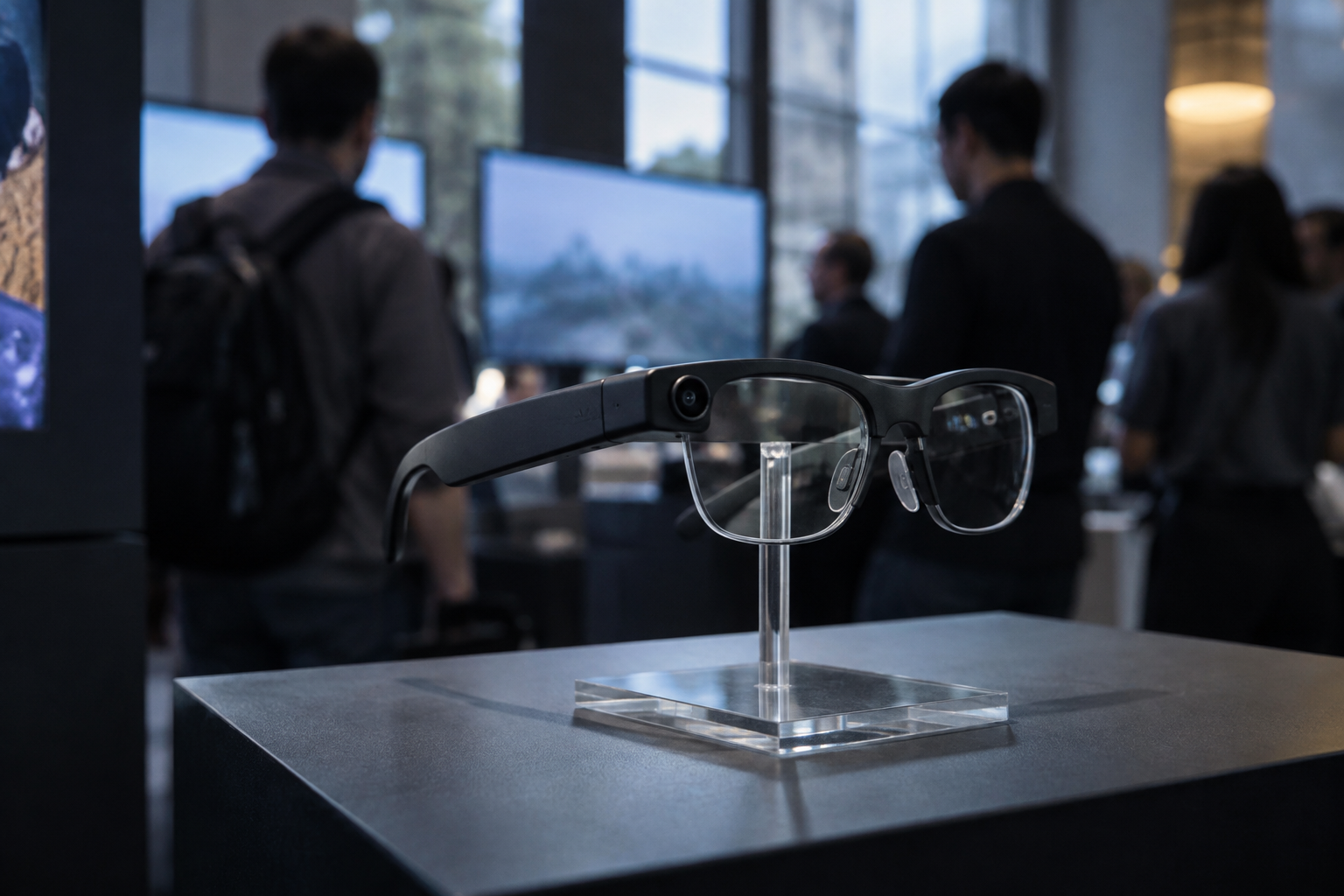
At Qualcomm's Snapdragon Summit on Wednesday, September 24, 2026, an AI startup called PrismML revealed that it managed to run its 1-bit Bonsai language model locally on hardware powered by the Snapdragon AR1 Gen 1 Platform. The demonstration put a 2-billion-parameter vision and language model directly on the glasses frame. Wearers point their face at an object, ask a question aloud, and the system processes the scene right then and there.
PrismML did this by shrinking larger baseline architectures by a factor of four. The compression technique slashes memory footprints while preserving standard benchmark performance across vision and text tasks. Instead of offloading the video feed to an offshore data center, the device handles both perception and response generation locally.
Every parameter in a traditional neural network usually consumes 16 bits or 8 bits of memory. Dropping to 1-bit weights cuts the mathematical workload down to bare-bones logic operations. That matters because the Snapdragon AR1 Gen 1 is an ultra-low-power silicon platform engineered specifically for thin, lightweight smart glasses rather than heavy virtual reality helmets.
Running a 2-billion-parameter multimodal model on that footprint proves edge silicon can do real multimodal reasoning without tethering to a phone or a cellular tower. PrismML demonstrated real-time visual question answering on the summit floor, showing zero reliance on external network handshakes to identify objects in front of the lens.
PrismML is not a run-of-the-mill wrapper operation. The company was founded by researchers out of Caltech and counts UC Berkeley computer science professor Ion Stoica as an advisor. Stoica is the same systems luminary who co-founded Databricks and Anyscale, meaning the engineering behind this model comes from distributed computing veterans who understand hardware bottlenecks.
The current smart glasses market is dominated by compromises. Most frames equipped with cameras simply stream compressed JPEG frames and voice snippets over Bluetooth to a smartphone, which sends those packets up to cloud servers hosted by Amazon Web Services or Microsoft Azure. That trip introduces a two-second latency penalty that kills fluid voice conversation.
Qualcomm introduced the Snapdragon AR1 Gen 1 platform to give hardware builders a dedicated tier of silicon for heads-up displays and sensor processing under a strict thermal envelope. The chip sits in temples measuring mere millimeters across, where heat dissipation cannot rely on cooling fans. Processing continuous video and audio inside that micro-watt cage has historically been impossible for modern multimodal networks.
PrismML’s Bonsai architecture bypasses that compute ceiling through radical quantization. Shrinking a model by 4x without watching its reasoning degrade on standard evaluation suites is a high-wire technical act. In older quantization schemes, pushing below 4-bit representation resulted in severe perplexity spikes and incoherent language output.
By optimizing the Bonsai weights down to 1-bit representations, the startup eliminated the bulky matrix multiplications that typically cook wearable batteries. The 2-billion-parameter count is deliberately chosen: large enough to comprehend visual context and spoken grammar, yet small enough to inhabit the on-chip memory limits of Qualcomm’s mobile processors.
PrismML is framing this release as a direct philosophical split from the hyperscalers. The startup is championing open-weight architectures that run locally on the silicon people already own, directly challenging the idea that consumers must surrender their sensor data to proprietary model operators.
Centralized labs want you to believe every question requires an eight-hundred-pound server rack. PrismML is betting that local silicon can handle your everyday vision without a cloud tax.
The startup pitches on-device execution as an ironclad privacy guarantee. When you wear a camera on your face, streaming continuous video to a third-party server creates an unbearable surveillance liability. Local execution means visual tokens never cross a Wi-Fi or cellular network.
Qualcomm, meanwhile, needs this software layer desperately. Silicon vendors can design low-power neural processing units all day long, but without specialized model builders squeezing weights onto those circuits, smart glasses remain glorified Bluetooth headsets. Showcasing Bonsai at the Snapdragon Summit gives Qualcomm a concrete proof point against custom silicon efforts from rival consumer giants.
Yet the room remains cautious, and for good reason:
The technology works on a test bench, but the consumer electronics pipeline is unforgiving. Qualcomm showcased the software on its reference hardware, but reference designs do not ship to retail shelves. PrismML must now convince original equipment manufacturers to license the stack and build consumer-ready frames around the Snapdragon AR1 Gen 1.
Thermal management during sustained voice dialogues is the immediate hurdle. Running 2 billion parameters on local silicon generates heat, and that heat sits against a user's temporal bone. Hardware engineers will have to balance continuous camera sampling rates with duty cycles to keep the glasses from warming up over ten-minute conversations.
The software battle is shifting toward latency and voice synthesis integration. Running vision processing locally solves the input bottleneck, but wearable voice agents also require fast, low-power speech-to-text and text-to-speech modules running on the same silicon. If an OEM pairs Bonsai with an unoptimized local voice synthesizer, the latency gains from 1-bit quantization evaporate.
PrismML is also challenging the business model of proprietary cloud AI labs. If open-weight 1-bit models provide sufficient situational awareness on edge silicon, the commercial rationale for paying per-token API charges for everyday visual assistance collapses. Device makers could ship smart glasses that run indefinitely without incurring recurring server bills.
Watch the upcoming hardware release cycles from Qualcomm's primary ecosystem partners. If an OEM steps forward to integrate PrismML's Bonsai model directly into retail firmware, it will mark the end of the cloud dependency era for ambient computing. If they hesitate, Bonsai will remain an impressive academic demonstration waiting for an industry bold enough to ditch the server rack.
Every wearable voice assistant on the market right now is an audio wiretap hooked to a remote server farm. If you want smart glasses that do not leak your surroundings or lag behind your train of thought, the intelligence must live on your nose bridge. PrismML proves that 1-bit compression can shove multimodal reasoning onto milliwatt hardware. It strips hyperscalers of their recurring cloud tax and gives hardware makers a clear exit ramp from cloud dependence.
Reported off TechCrunch AI. Original reporting and analysis by Selma Ortiz for Vox Roboti.
Bonsai is a 2-billion-parameter vision and language model compressed to 1-bit weights, built by PrismML to run locally on low-power devices like smart glasses.
The model runs directly on Qualcomm's Snapdragon AR1 Gen 1 Platform, designed specifically for smart glasses.
No. Qualcomm and PrismML demonstrated the model on reference hardware, but no manufacturer has announced a retail device using the technology yet.
The 2-billion-parameter network combines vision and language processing on the frame, allowing wearers to ask what they are looking at in real time without cloud routing.
PrismML was founded by Caltech researchers and is advised by UC Berkeley professor Ion Stoica.
PrismML shrank the model by 4x, maintaining near-complete benchmark performance while fitting into local wearable silicon.
Selma Ortiz · 17h ago · 4 min read

Cass Iverson · 2d ago · 5 min read

Selma Ortiz · 2d ago · 5 min read