Voice AI
Amazon Silently Kills Alexa Voice Switching for Older Echo AUX Jacks
Selma Ortiz · 16h ago · 4 min read
OpenAI taught its voice agent to fake human stutters. Google gave its bot your Gmail inbox. Here is what actually happens when you talk to them.

By Ray Dalton, Editor-in-chief · Reported off Engadget
Runs the desk. Allergic to demos that only work on stage.
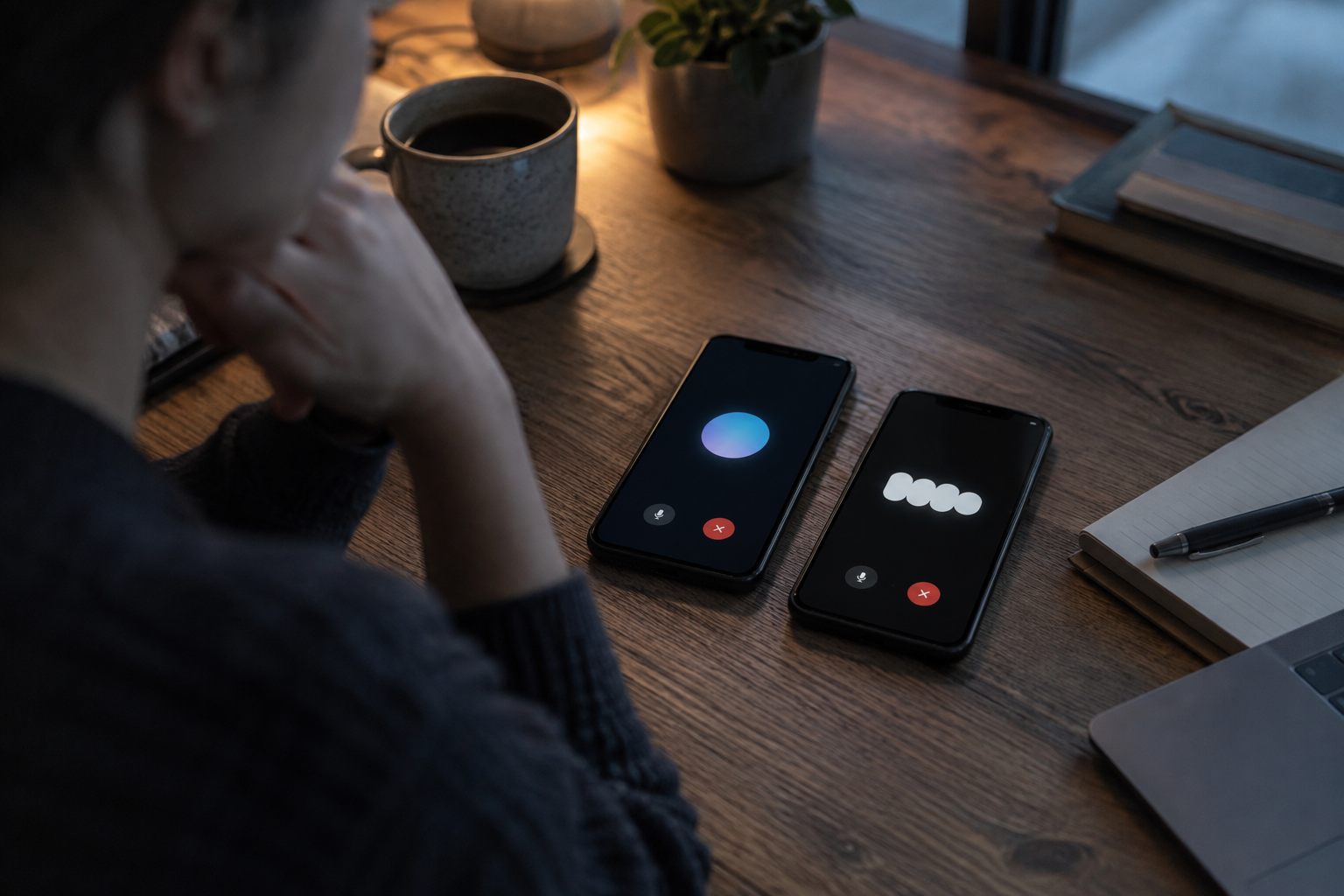
Put two voice chatbots in a room and ask them to explain a software update released five minutes ago. One fakes a throat-clearing breath, pauses for two seconds, checks the live web, and hands you the correct answer. The other speaks in a flat, clinical cadence and insists the update does not exist.
That was the exact outcome when tech reviewer Calvin Wankhede pitted OpenAI's ChatGPT Voice against Google's Gemini Live in late September 2026. Asked about the Gemini 3.8 Live release, Google's flagship conversational model leaned entirely on stale internal weights, hallucinated a negative, and flatly denied its own software existed. ChatGPT Voice stopped, pinged live search indexes, and recited the accurate changelog. To make Gemini Live pull recent data, the user has to stop speaking naturally and issue an explicit prompt demanding live research.
Yet beneath the conversational hood, Google built a surveillance apparatus disguised as an assistant. Gemini Live connects directly to a user's Google account via a system branded as Personal Intelligence. When queried aloud about monthly expenses, Gemini Live scans private Gmail inboxes, extracts utility notices, surfaces drive documents, and reads back the tally within seconds. OpenAI has no access to Google Maps, YouTube history, or personal email threads. It cannot add an event to your calendar while you chat. It knows nothing about your inbox, but it sounds like an actual human who gives a damn.
That contrast defines the entire voice AI market in 2026. OpenAI prioritized synthetic conversational texture, programming mid-sentence stutters, filler words like "mhmm", and vocal intonation changes that simulate active cognition. Google prioritized back-end integration, tethering Gemini Live to its legacy Android, smart display, and email stack while leaving the vocal delivery flat, monotonous, and prone to static database cutoffs.
Hardware deployment shows an even wider split. Google pushed Gemini Live onto consumer hardware reaching all the way back to the 2017 Google Home Mini, alongside Nest Audio, Nest Hub units, and Pixel Buds. Access on those smart home speakers carries a gate: owners must pay a $10 monthly Google Home Premium subscription. OpenAI has zero native smart home hardware on retail shelves, leaving conversational users stranded on mobile devices while its hardware division scrambles to finish prototypes.
Text boxes ruled consumer AI when OpenAI released ChatGPT in November 2022. Typing prompts into a terminal was fine for coders and writers, but consumer voice interfaces stalled out for a decade on rigid syntactic trees built for Siri and the legacy Google Assistant. Those systems collapsed if a speaker changed their mind mid-sentence or used conversational tangents.
Real-time voice models upended that pipeline by bypassing text-to-speech transcoding bottlenecks. Instead of transcribing speech to text, passing text to a large language model, and running the answer through a mechanical voice synthesizer, modern voice systems process direct audio tokens to minimize conversational latency. Speed is the enemy of raw intelligence here. Both OpenAI and Google quietly downgrade their underlying voice engines to lightweight models to prevent awkward multi-second silences. ChatGPT runs its voice interactions on smaller architectures like GPT-Live-1 mini on free tiers, stepping up to larger GPT-Live-1 systems only on paid accounts. Neither engine matches the reasoning depth of its flagship text counterpart.
Compute budgets dictate every design choice in audio processing. Processing continuous, bidirectional audio streams costs exponentially more server compute than batching text tokens. Because of that burn rate, both platforms place severe constraints on non-paying users:
Multimodal visual processing exposes OpenAI's aggressive paywalling. Both applications let users point their smartphone camera at real-world objects while holding a live voice dialogue. In field testing, Gemini Live successfully guided a user through a mechanical bicycle tune-up, actively overlaying graphic markers across the live camera display to pinpoint which bolts required tightening. Google provides that live camera parsing on its free tier. OpenAI strictly gates real-time camera voice integration behind its $20 monthly subscription, stripping it entirely out of both the free app and the $8 ChatGPT Go plan.
Wankhede highlighted the visceral uncanny valley dividing both voice stacks:
"ChatGPT Voice tends to be much more expressive in its word selection and uses natural conversational markers in an attempt to sound more human."
Critics point out that OpenAI's vocal gymnastics can backfire. By forcing the GPT-Live architecture to stutter, drop synthetic "mhmm" affirmations, and vary pitch dramatically, OpenAI built an agent that some users find manipulative and performative. Detractors describe the breathy vocal modulation as an irritating facsimile of human empathy, designed to trick lonely users into forming parasocial bonds with a machine.
Google took the opposite path with Gemini Live, producing a predictable, measured, and emotionally detached vocal tone. Enterprise adopters often praise that flat delivery because it avoids dramatic swings during transactional inquiries. The compromise is sterile voice interaction that feels uncomfortably close to automated airline phone trees, even when Gemini is doing heavy computational lifting inside a user's Drive folder.
Hardware analysts focus on the monetization tax Google slapped on its smart home footprint. Pushing Gemini Live down to a 2017 Home Mini sounds benevolent until users discover the $10 monthly Google Home Premium toll. Smart home owners argue that paying a recurring subscription to restore conversational literacy to a nine-year-old plastic speaker is an aggressive hardware cash grab. Meanwhile, mobile-first users argue that OpenAI's total absence from smart home hardware makes ChatGPT Voice useless in living rooms and kitchens.
The pricing war will intensify at the sub-$10 tier as hardware ecosystems lock down their users. Google already weaponized its infrastructure by pricing AI Plus at $5 monthly while bundling 400GB of storage for multi-user households. OpenAI cannot match that hardware and storage packaging. An $8 ChatGPT Go subscription buys conversational processing time and nothing else. If OpenAI fails to launch its dedicated consumer hardware soon, it risks losing the ambient domestic market entirely to Google's installed base of smart displays and smart speakers.
Search architecture will decide voice retention. A voice agent that cannot browse the live internet accurately without being prompted is broken. Google's blunder with Gemini Live hallucinating the non-existence of its own 3.8 release exposes an internal conflict: Google wants voice agents to be fast, but speed sacrifices the real-time web retrieval pipeline that built its corporate empire. If Google does not automate background search indexing on every verbal query, power users will migrate to ChatGPT Voice simply because OpenAI looks before it leaps.
Data privacy boundaries will face severe legal testing under Gemini's Personal Intelligence banner. Because Gemini Live can dig through Gmail bills, personal calendars, and private cloud drives on a casual spoken command, accidental acoustic activations inside homes represent a massive corporate liability. An ambient microphone that blurts out financial statements to anyone standing near a Google Home speaker crosses a line text chat never approached.
OpenAI faces a compute wall on real-time vision. Gating camera features behind the $20 tier protects server infrastructure, but it hands Google a visual advantage in mechanics, education, and physical troubleshooting. Once consumers experience real-time spatial overlays on a free tier, paying OpenAI $240 a year for equivalent optical tools becomes an impossible sell.
Voice AI is splintering into two incompatible business models. OpenAI is selling an expensive, polished personal actor that mimics human cadence while running blind to your digital identity. Google is weaponizing its ubiquitous Android and workspace surveillance empire, turning every legacy smart speaker into an ambient corporate terminal. If you want natural banter and honest search results, you pay OpenAI. If you want an agent that actually controls your physical hardware and manages your messy inbox, you sell your soul to Google.
Reported off Engadget. Original reporting and analysis by Ray Dalton for Vox Roboti.
ChatGPT Voice sounds more natural because it uses pitch shifts, conversational pauses, and humanlike verbal fillers like stutters.
Yes. Gemini Live uses Personal Intelligence to pull billing statements, search Drive files, and check Gmail messages on command.
ChatGPT offers limited free access, an entry-level Go plan for $8 monthly, and a flagship tier for $20 monthly.
Yes. Gemini Live runs on Nest devices and the 2017 Home Mini, but requires a $10 monthly Home Premium plan.
Yes. ChatGPT Voice automatically accesses current internet data before answering, whereas Gemini Live often defaults to static offline memory.
Google provides camera input for free on Gemini Live. OpenAI restricts live camera voice input to its $20 monthly plan.
Processing streaming bidirectional voice requires massive computing power, forcing both companies to restrict session length on unpaid tiers.
Selma Ortiz · 16h ago · 4 min read

Cass Iverson · 2d ago · 5 min read

Selma Ortiz · 2d ago · 5 min read