
Voice Agents
Google Drops the Fitbit Edge and Tightens the Hardware Trap
Priya Raghunathan · 2d ago · 5 min read
TechCrunch Disrupt 2026 lands in San Francisco with agentic systems, robotics, and cut-rate tickets for laid-off tech workers.

By Nina Falco, Front-desk beat reporter · Reported off TechCrunch Venture
Sold answering services to dentists. Now she reports on them.
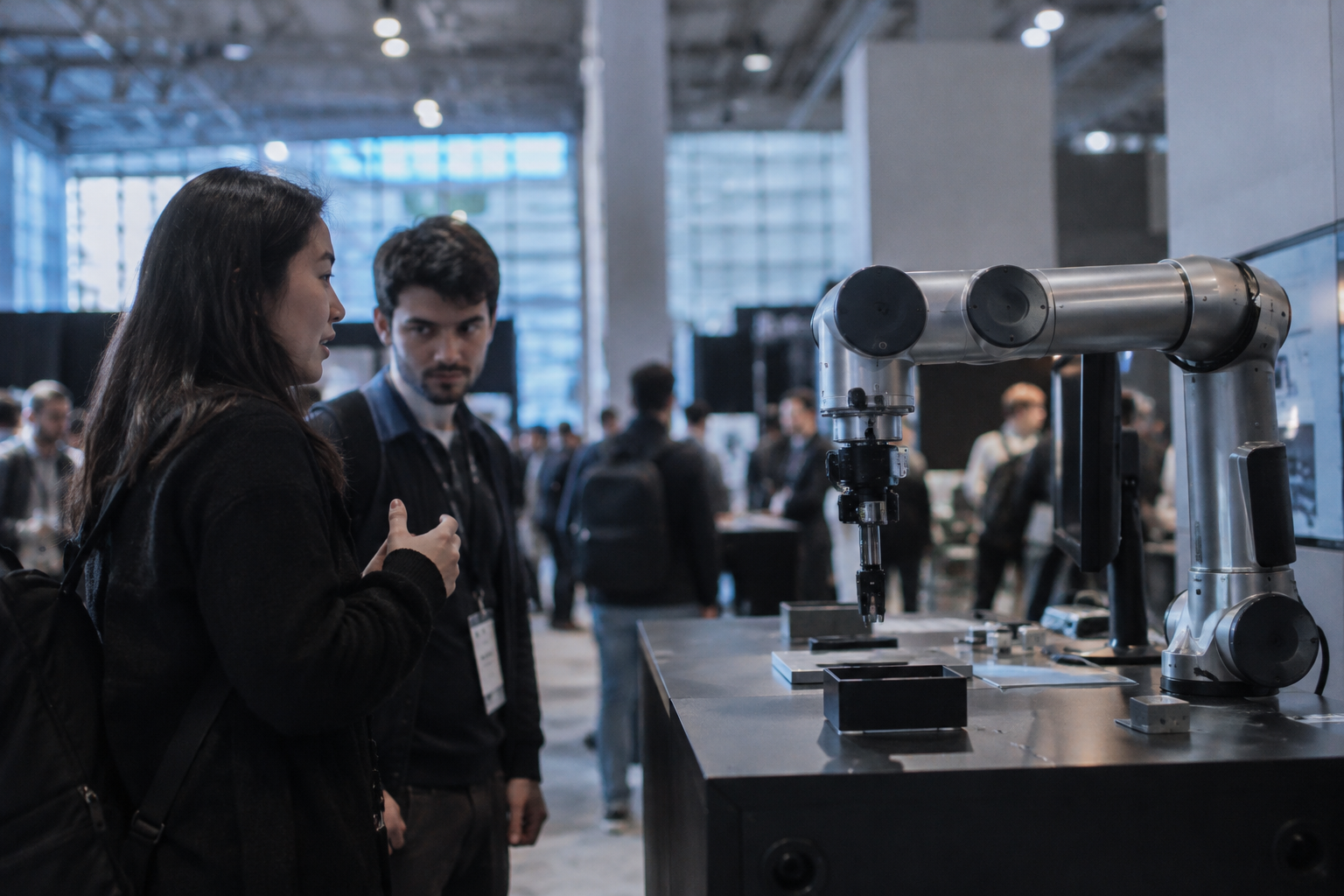
San Francisco gets its annual tech carnival back on October 13, 2026. The Moscone West convention center opens its doors at 8 a.m. PT for TechCrunch Disrupt 2026. The three-day marathon runs through October 15, pulling roughly 10,000 founders, investors, and operators under one roof.
Ticket pricing operates on a familiar ticking clock. Early registrants grab passes starting at $299, while latecomers face walk-up penalties running up to $100 higher at the entrance. The organisers rolled out two-for-one discount structures offering 50 percent off a second ticket, alongside tier packages for groups numbering four or more.
The floor also holds a $75 Expo+ pass reserved strictly for laid-off tech workers. That single ticket tier reflects the employment shakeup rattling enterprise software and engineering departments across Silicon Valley throughout 2026.
Six dedicated stages host more than 200 sessions. Over 300 early-stage exhibitors secured booths on the show floor, following an October 2 cutoff date for display reservations. The centerpiece remains the Startup Battlefield 200, an onstage pitching arena where seed-stage contenders compete for capital and visibility in front of venture partners.
Agentic software commands the prime speaking tracks. Dedicated sessions tackle autonomous workflows, generative tools, and voice-driven systems across software suites and embedded hardware devices.
Silicon Valley spent two years pushing text prompts into enterprise dashboards. Now the focus has shifted toward voice agents that execute multi-step tasks without human oversight. That pivot explains why the agenda at Moscone West looks drastically different from software conferences held two years ago.
The AI Stage centers squarely on generative models and agentic deployments. Speakers from Anthropic, OpenAI, AWS, and Luma lead the technical tracks. They are walking onto the platform at a moment when Anthropic is handing out a free year of Claude Team alongside $1,000 in API credits to reel early-stage builders into its model orbit.
Hardware makers are racing to package these models into standalone products. Take Ghost, which raised $11 million at age 19 for founder-led operations to ship a $3,499 personal computing device built around dedicated artificial intelligence. That hardware push sits alongside Cerebras Systems, whose chief executive Andrew Feldman takes the Disrupt Stage to outline compute acceleration against entrenched chip incumbents.
Physical machinery shares equal billing with purely digital intelligence. The Real World AI Stage brings in Agility Robotics, Waabi, and General Motors to demonstrate autonomous fleets and bipedal machines operating on real factory floors. Live robotics demonstrations will test whether speech-driven commands and physical actuation can survive unscripted scrutiny.
The transition from screen-bound chatbots to agentic, autonomous voice and physical robotics marks the real dividing line at Moscone West.
Infrastructure providers fill out the remaining hall tracks. The Smart Systems Stage assembles Helion, Ambrosia Energy, and Inertia to talk through the immense power drain required to run dense model clusters. Compute needs power, and power needs land rights, which has already pushed operators like Amazon to scrap non-disclosure agreements following community resistance around municipal data center construction.
Inside the enterprise track, software veterans view agentic voice as the frontline interface for everyday workflows. Builders Stage presenters from Nvidia, Google Cloud, Uber, and Lovable are framing autonomous voice agents as functional replacements for bloated web dashboards.
Corporate venture teams view the convergence of voice systems and physical units as the next wave of capital deployment. Founders on the Disrupt Stage, including Max Hodak of Science Corporation and Garrett Langley of Flock, represent the two poles of physical computing: neural interfaces on one side, and wide-area vehicle tracking networks on the other.
Flock arrives under acute scrutiny after a federal judge publicly branded its automated camera grid as indiscriminate mass surveillance. That legal friction highlights the regulatory walls waiting for autonomous monitoring agents and automated voice systems deployed in civic spaces.
Internal corporate friction adds another layer of tension to the conference floor. Resignations inside OpenAI over institutional safety culture have opened wider skepticism among enterprise buyers who demand predictability before wiring voice agents into customer-facing phone trees.
Meanwhile, labour policy shifts complicate engineering roadmaps across the sector. Federal authorities recently moved to block major IT employers, including Microsoft and Adobe, from specific green card programs for foreign technical talent, leaving engineering leads scrambling for high-end machine learning specialists.
Celebrity involvement also lands on the main stage, with Mark Wahlberg making a scheduled appearance among the founders and fund managers. His appearance signals the lingering consumer appetite for celebrity-backed lifestyle platforms even as enterprise venture capital tightens its focus onto deep infrastructure and unit economics.
Once doors swing open at 8 a.m. on October 13, the tone will be set by the Startup Battlefield 200 contenders. Investors expect live product demonstrations rather than slide presentations. If a voice agent stumbles on latency or misinterprets instructions during an onstage demo, the room will notice immediately.
The three-day agenda splits across several specialized tracks:
Fintech operators will crowd the Smart Money Stage to see how Robinhood, Airwallex, and American Express reconcile automated settlement rails with agentic consumer interfaces. As voice agents take over commercial buying decisions, the underlying payment routing must adapt to non-human purchasers.
For job seekers carrying the $75 layoff pass, the Expo Hall offers direct access to 300 engineering organizations that are still hiring. Those booths represent a live sanity check on whether autonomous voice tooling is displacing technical jobs or simply shifting headcount toward systems architecture and edge deployment.
When the Moscone West hall empties on the evening of October 15, the industry will have a clearer metric of where autonomous voice agents actually work. Pitch decks will step aside, and working code under live customer loads will decide who survives the next funding winter.
Conference stages reveal where venture capital actually flows when the marketing dust settles. The heavy tilt toward agentic architectures and physical hardware at Moscone West shows that plain conversational chatbots no longer command premium valuations. Enterprise buyers want voice agents that can independently manipulate software tools, trigger payments, and command physical machinery on shop floors. If voice systems cannot demonstrate reliable execution without continuous human correction, enterprise software budgets will bypass them entirely.
Reported off TechCrunch Venture. Original reporting and analysis by Nina Falco for Vox Roboti.
Disrupt 2026 opens its doors at 8 a.m. PT on October 13, 2026, at Moscone West in San Francisco.
Discounted registration starts at $299, with late door passes costing up to $100 more. A second pass is 50 percent off.
Yes. The Expo+ Layoff pass costs $75 for qualifying workers before current ticket allotments sell out.
Technical executives from Anthropic, OpenAI, AWS, and Luma lead discussions covering agentic systems and generative models.
Agility Robotics, Waabi, and General Motors will run real-world robotics and autonomous systems demonstrations.
Startup Battlefield 200 is an onstage pitch competition where early-stage startups compete directly before venture capitalists.
Priya Raghunathan · 2d ago · 5 min read

Nina Falco · 3d ago · 5 min read

Devon Achebe · 4d ago · 4 min read