Voice AI
Amazon Silently Kills Alexa Voice Switching for Older Echo AUX Jacks
Selma Ortiz · 16h ago · 4 min read
Amazon's Alexa for Shopping can now track price drops across 365 days and pull the trigger on purchases without your final sign-off.

By Devon Achebe, Infrastructure reporter · Reported off Engadget
Follows latency, cost and the parts of the stack vendors hide.
Amazon just handed its voice assistant the power to empty your checking account on a trigger. The company rolled out an autonomous purchasing system inside Alexa for Shopping, the retail-focused AI assistant previously known across the ecosystem as Rufus. For eligible Prime subscribers in the United States, the platform no longer stops at pinging your phone when an item gets cheaper. If you give the command, it completes the transaction the second the price drops to your chosen threshold.
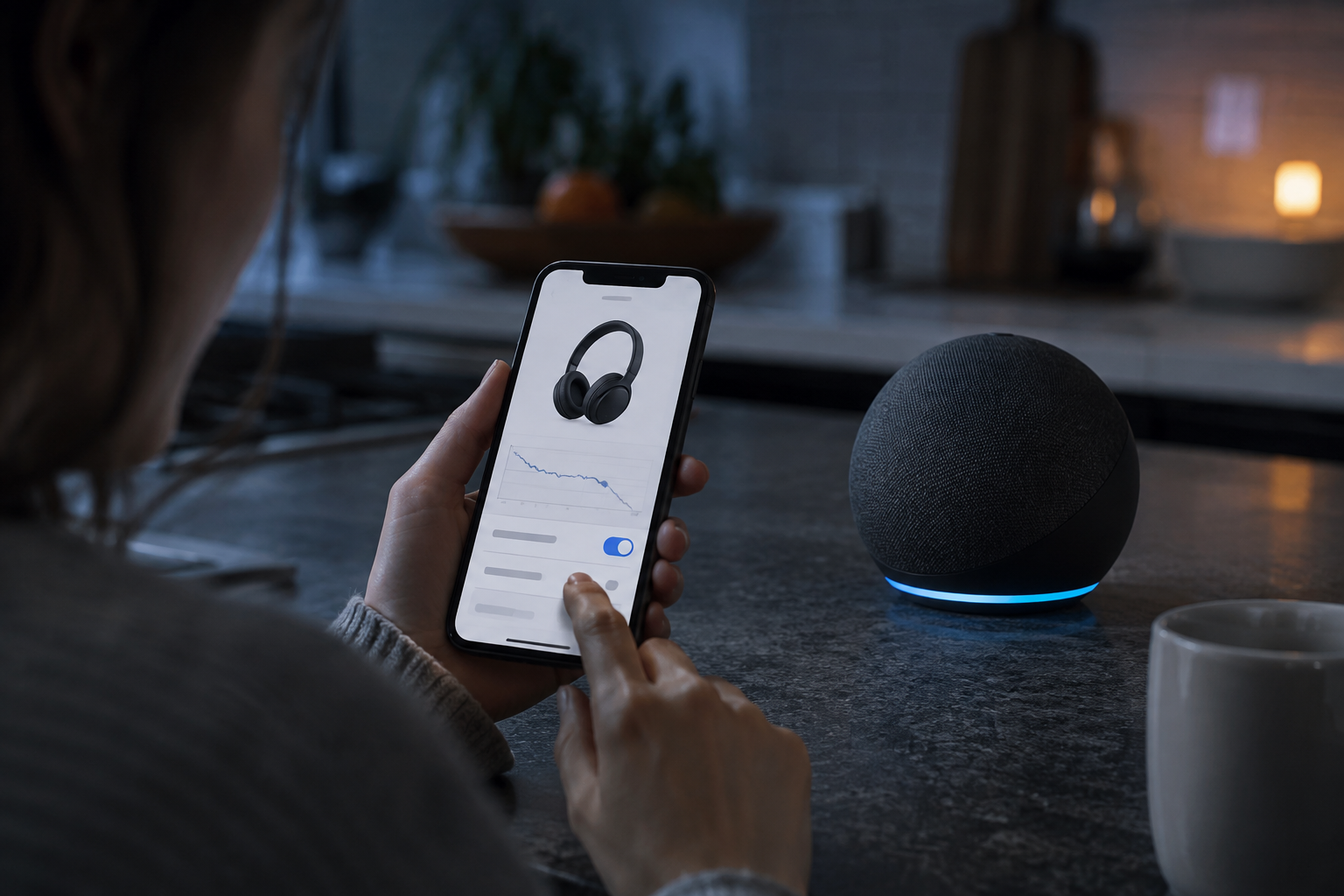
Setting up the workflow requires navigating Amazon's built-in Price History interface. On a desktop browser, shoppers access this data through a blue button positioned adjacent to the product price. Mobile users on iOS and Android find it styled either as a white button outlined in blue or as a plain text link. Tapping that interface surfaces historical price fluctuations across 30, 90, and 365-day evaluation windows, showing whether a current listing represents a genuine markdown or a routine pricing cycle.
From there, shoppers can verbally assign a price floor or ceiling to Alexa for Shopping on Amazon.com, within the mobile app, or directly to an Echo smart speaker in the living room. Telling the assistant, "Buy these headphones when they are $75 or less," binds the instruction to the account's default payment method and shipping address. The system then polls the listing in the background. When the seller or Amazon's algorithm cuts the price to $75, the order executes automatically without requiring a secondary confirmation or push-notification approval.
The convenience comes with hard limits that penalize careless configuration. The Auto Buy engine completely ignores digital coupons and limited-time promotional voucher codes clipped on the product page. If a $100 pair of earbuds carries a 25 percent off on-page coupon, Auto Buy skips the discount entirely and waits until the sticker price itself drops. Furthermore, the automated checkout routine calculates state sales tax and shipping surcharges on top of the target bid, meaning an order set at a strict $75 threshold will bill higher once local taxes apply.
Shoppers who do not hold a paid Prime subscription are barred from using the transactional trigger. Non-Prime users can still view the 365-day price history graphs and register basic price watch alerts, but the actual transaction execution remains locked behind the Prime paywall. If a user has system notifications disabled at the operating system level—under app settings in iOS or Android—the manual alert pipeline fails completely, leaving autonomous purchase records visible only after the confirmation receipt hits the user's email inbox.
Automated price monitoring on Amazon is not new, but delegating the checkout execution to Amazon's native AI fundamentally breaks third-party utility. For over a decade, independent tracking portals like CamelCamelCamel and Keepa served as the standard toolset for disciplined shoppers. Those services gave consumers transparency by scraping marketplace fluctuations and firing an email alert when an item crossed a target line. Yet external services were deliberately limited by Amazon's closed architecture: they could alert the buyer, but they could never place the order.
External trackers could spot the deal, but only Amazon held the keys to the checkout register.
By retooling Rufus into Alexa for Shopping and integrating native price charts, Amazon has effectively internalized the third-party deal-tracking industry. The software giant spent years allowing Echo hardware to chime in with unsolicited yellow-ring notifications about discounts on previous purchases or abandoned cart items. Those notifications relied on users walking over to the speaker, asking what the alert was, and verbally agreeing to buy. Alexa for Shopping removes the intermediate friction entirely.
This shift also reflects how modern e-commerce pricing engines operate. Third-party merchants and retail algorithms alter prices thousands of times a day based on inventory levels, competitor activity, and supply chain updates. A flash sale on an item might last for twenty minutes at three o'clock in the morning. An external browser extension pinging an inbox cannot capitalize on a ten-minute price collapse while the customer is asleep. An internal agent with stored payment credentials can.
Beyond specific product listings, the revised shopping agent expands tracking into abstract product categories. Users are no longer forced to identify a single, specific Amazon Standard Identification Number (ASIN) to establish a monitor. Alexa for Shopping accepts open-ended conversational constraints covering product type, maximum budget, preferred color, and explicit technical specifications, such as:
Power shoppers and deal communities are treating the update as a double-edged sword. On one side, buyers targeting high-demand electronics see native automation as the only viable countermeasure against automated reseller bots. By handing execution directly to the storefront hosting the inventory, consumers bypass the latency of email notifications and out-of-stock errors that plague manual purchases during major sales events.
Critics and consumer advocates, however, point directly to the financial traps baked into the implementation. The refusal of Auto Buy to parse promotional vouchers and clipped coupons means autonomous buyers frequently pay higher net prices than shoppers who manually review their carts at checkout. A customer relying on Auto Buy to grab an item at an advertised $80 target will miss a manufacturer's 20 percent checkout voucher that would have dropped the manual price to $64.
Hardware owners also voice skepticism regarding Echo ambient alerts. Echo devices have a reputation for aggressively surfacing marketing prompts disguised as helpful notifications, often waking households to announce markdowns on consumables ordered six months prior. The fear among voice-first households is that opening the door to voice-prompted purchases will accelerate Amazon's aggressive upselling across smart screens and speakers.
The rollout of automated purchasing marks the transition from conversational voice bots to transactional agentic software. Up to this point, voice assistants acted as fancy remote controls—setting timers, playing music playlists, or reading weather reports. By linking language models directly to default payment rails, Amazon is attempting to condition users into letting algorithms manage discretionary capital without human review.
That dynamic creates immediate friction for third-party merchants operating on the Amazon marketplace. Sellers routinely adjust prices dynamically to test elasticity or liquidate stale inventory in small batches. With Alexa for Shopping parsing 365-day historical baselines and executing instant orders for buyers, merchants will lose the ability to deploy temporary price drops without triggering immediate, automated sweeps from waiting buyers.
For competing retail platforms, the pressure intensifies. Neither Google nor Apple possesses an integrated, native retail logistics network capable of backing up voice instructions with same-day fulfillment and proprietary price histories. While competitors scramble to make their voice assistants capable of drafting emails or summarizing meeting transcripts, Amazon is quietly converting its smart home footprint into an autonomous, voice-activated point-of-sale terminal.
Voice assistants spent a decade stuck as glorified kitchen timers because tech giants could not bridge the gap between spoken words and paid transactions. By fusing 365-day pricing charts, autonomous checkout, and Echo hardware, Amazon turned Alexa into an automated trading desk for household goods. This is not casual voice search; it is agentic retail that eliminates human cart inspection, sidelines third-party tracking portals, and cements Prime's lock on consumer spending.
Reported off Engadget. Original reporting and analysis by Devon Achebe for Vox Roboti.
Yes. Prime members can tell Alexa for Shopping to buy an item when it drops to a specific price or lower. The order executes automatically using default account payment details.
Yes. While any shopper can view price histories and receive price alerts, the Auto-Buy purchase feature requires an active Prime membership.
No. The Auto-Buy system ignores digital coupons and promotional vouchers. It only triggers based on the standard sticker price of the product.
The native Price History tool allows shoppers to inspect pricing trends across 30, 90, or 365 days directly on the listing page.
No. Third-party tools like Keepa and CamelCamelCamel can only monitor listings and send notifications. They lack the authority to execute purchases on Amazon.
Yes. You can instruct Alexa for Shopping to track broad categories like espresso machines with custom constraints on budget, color, and technical features.
Selma Ortiz · 16h ago · 4 min read

Cass Iverson · 2d ago · 5 min read

Selma Ortiz · 2d ago · 5 min read