Voice AI
Apple HomeView Code Leak Turns Countertop Hubs Into Security Eyes
Cass Iverson · 9h ago · 5 min read
Slapping prescription lenses into Meta frames sounds like frictionless computing. Then the battery dies by lunchtime and courtrooms kick you out for wearing corrective glass.

By Selma Ortiz, Product and labs writer · Reported off Engadget
Tests every model on ugly, real calls. Writes reviews vendors dread.
You cannot take off your glasses when your eyes do not work without them.
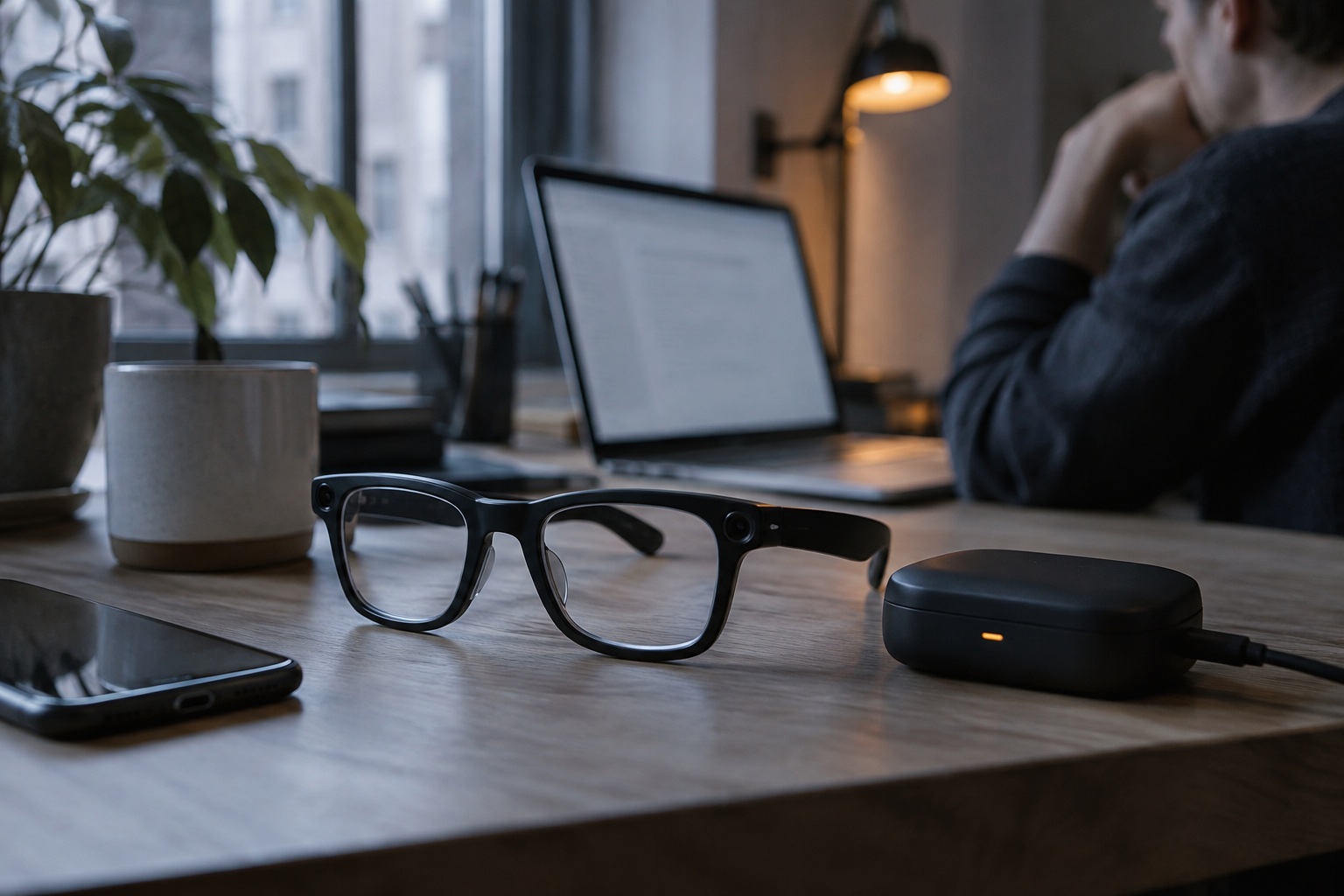
That simple medical reality is colliding directly with Silicon Valley's wearable ambitions. Hardware vendors now let you upload an optical prescription and receive smart eyewear configured to correct your vision right out of the box. Ray-Ban Meta frames handle the ordering workflow directly through their digital storefront, swapping standard glass for corrective lenses so you never have to layer gadgets over your spectacles. The pitch promises an ambient voice assistant resting on your ears all day, parsing speech and translating dialogue without pulling a phone from your pocket.
It sounds clean on a checkout page. On your face, the arrangement deteriorates within hours.
Prescription smart frames transform an optional gadget into an involuntary biometric anchor. When an enterprise executive or student orders corrective lenses inside AI eyewear, they are making a singular piece of hardware responsible for both optical navigation and ambient compute. You cannot simply slide the frames into a pocket when an environment turns hostile to recording gear or when the battery reaches zero percent. You either keep wearing them blind to their intelligence, or you carry a second, conventional pair of glasses everywhere you walk.
Physical mass is the first operational barrier. Traditional corrective spectacles weigh between 20 and 30 grams, or roughly 0.7 to 1.1 ounces. Smart frames pack batteries, dual microphones, mainboards, speakers, and camera sensors into the chassis, driving total weight up to 80 grams, or approximately 2.7 ounces. Tripling the load on the bridge of your nose alters the physics of everyday wear. What feels negligible during a thirty-minute demo creates acute cartilage pressure and skin irritation when worn continuously across a sixteen-hour waking shift.
Then comes the power budget. Current AI eyewear provides an operational runtime of three to five hours per charge cycle under moderate use. A human being requires optical correction for roughly sixteen hours each day. That mathematical mismatch forces owners to plug their medical necessity into a charging case three to four times before dinner, leaving them without sight or tethered to a wall outlet.
Ambient voice processing cannot rescue an interface when the silicon dies before lunch, leaving eighty grams of dead plastic sitting on your nose.
Once the lithium-ion cell runs dry, every ambient feature vanishes immediately:
Silicon Valley built voice-activated eyewear to liberate users from smartphone touchscreens, betting that microphones and micro-speakers would feel invisible. Early iterations treated audio and camera frames as luxury accessories for sunny afternoons. The pivot toward prescription integration is an attempt to capture permanent platform territory on the user's face, turning discretionary gadgets into mandatory daily utilities. If you cannot leave the house without optical correction, Meta and its hardware partners own your sensory input from breakfast to bedtime.
That corporate capture triggered immediate regulatory and civil friction across Europe. A German non-profit organization filed a formal criminal complaint targeting the privacy architecture of Meta's smart glasses. European privacy watchdogs zeroed in on the hardware's outward-facing sensors, questioning whether passive bystanders can ever meaningfully consent to ambient optical and acoustic monitoring in public squares.
The data loop running behind these frames justified that regulatory alarm. Meta faced public scrutiny after disclosures revealed that outsourced contractors were granted access to sensitive, intimate media recorded through user glasses. Workers hired through external vendor contracts reviewed private images and audio clips captured inside domestic spaces. Meta defended the workflow by stating that human moderation and review exist solely to refine algorithmic models and elevate product performance. For users wearing corrective lenses, that data intake captures everyday domestic life without pause.
Acoustic data pathways introduce identical vulnerabilities in professional settings. Smart frames promote real-time audio translation as an executive feature. Executing that translation requires voice streams to leave the local chassis, travel through external cellular networks, and hit remote corporate servers for processing. Proprietary boardroom discussions, customer negotiations, and confidential legal consultations instantly become ingested cloud inputs the moment the wearer enables linguistic assistance.
Legal and educational authorities are responding by cordoning off public and institutional spaces from wearable AI. Courts across England and Wales enacted strict prohibitions barring Meta smart glasses from their proceedings, classifying the frames as unapproved recording apparatuses. Judicial administrators in New York followed suit in July, barring visitors and attorneys from wearing the frames inside their judicial facilities to prevent unauthorized surveillance of witnesses and jurors.
Academic systems are drawing identical perimeters. School boards and university faculties across multiple continents now ban students from wearing AI glasses in classrooms. Administrators cite real-time academic integrity risks and student privacy violations. When those frames hold your actual vision prescription, a classroom ban forces a student to sit through a lecture visually impaired or maintain duplicate eyewear in their backpack.
Corporate campuses are quietly implementing matching blacklists. Corporate security divisions routinely prohibit wearable sensors inside research labs, financial deal rooms, and sensitive engineering facilities. Security leads argue that an employee cannot prove a microphone is inert simply because the onboard camera is not visibly streaming. A real-time translation tool listening for foreign syntax poses the exact same corporate leakage hazard as an open smartphone recording line.
Public perception has deteriorated in tandem with institutional bans. Consumers who bought the hardware for hands-free audio are shelving their pairs after facing social friction on public transit and in hospitality venues. Wearers report intense social pushback from colleagues and bystanders who suspect ambient surveillance, creating an uncomfortable social tax. Nobody wants to be tagged as an office voyeur simply because they ordered progressive lenses inside connected acetate.
The fundamental conflict facing prescription AI frames is the legal collision between digital surveillance policies and medical accessibility rights. If a citizen requires prescription lenses to navigate physical space, kicking them out of a municipal office or a courtroom for wearing smart glasses creates an immediate accessibility dispute. Regulators will be forced to determine whether an enterprise can lawfully demand the removal of visual prosthetics when those prosthetics house integrated wireless surveillance sensors.
Hardware engineers cannot easily engineer their way out of the mass penalty. Battery chemistry does not bend to consumer marketing desires. Squeezing sixteen continuous hours of voice-processing power, camera standby, and wireless connectivity into a 25-gram frame requires battery density improvements that currently do not exist in consumer electronics. Shaving weight means shrinking cells, which shortens the already dismal three-hour lifespan even further.
The voice AI industry faces an immediate strategic crossroads. Companies must either design local-only silicon that eliminates third-party cloud streaming, or accept that smart glasses will remain banned across high-security environments. As long as onboard microphones pipe acoustic data back to external contractor databases, smart frames will be treated as industrial recording rigs rather than wearable eyeglasses.
Buying prescription AI frames today locks you into a compromised device. You pay premium lens prices for an 80-gram brick that dies before your workday ends and gets you kicked out of legal proceedings. Until the industry solves local processing, weight balance, and battery endurance, keeping your medical prescription separate from your smart speaker remains the only rational choice.
When Big Tech turns vision correction into an always-on surveillance vector, accessibility clashes directly with corporate security. Voice AI wants permanent residence on your face, but institutional blacklists, contractor surveillance loops, and three-hour batteries prove ambient computing still cannot outrun basic optical physics.
Reported off Engadget. Original reporting and analysis by Selma Ortiz for Vox Roboti.
Yes. Ray-Ban lets buyers upload an optical prescription to receive smart frames with corrective lenses pre-installed.
They last between 3 and 5 hours before needing a recharge, leaving wearers without AI features for most of the day.
Standard glasses weigh 20 to 30 grams, while smart frames weigh up to 80 grams due to internal hardware.
Courtrooms in England, Wales, and New York ban them, alongside many classrooms and corporate environments worldwide.
Yes. Features like real-time translation transmit conversations to remote servers, raising leaks in confidential settings.
Yes. Meta uses outsourced third-party contractors to review captured images and footage to train and improve systems.
They still function as normal prescription lenses, but all voice processing, audio, and camera capabilities turn off completely.
Cass Iverson · 9h ago · 5 min read
Selma Ortiz · 1d ago · 4 min read

Cass Iverson · 2d ago · 5 min read