Voice AI
Amazon Silently Kills Alexa Voice Switching for Older Echo AUX Jacks
Selma Ortiz · 17h ago · 4 min read
OpenAI strapped GPT-6 Astra to your inbox, calendar, and Slack channels. Voice AI is no longer a parlour trick, but giving it agency over your workplace brings real trouble.

By Devon Achebe, Infrastructure reporter · Reported off The Decoder
Follows latency, cost and the parts of the stack vendors hide.
OpenAI just turned its audio toy into an office operator. The company pushed a global update to ChatGPT Voice on September 23, 2026, dropping three new engines under the hood: GPT-6 Astra, GPT-6 Sol, and GPT-6 Luna.
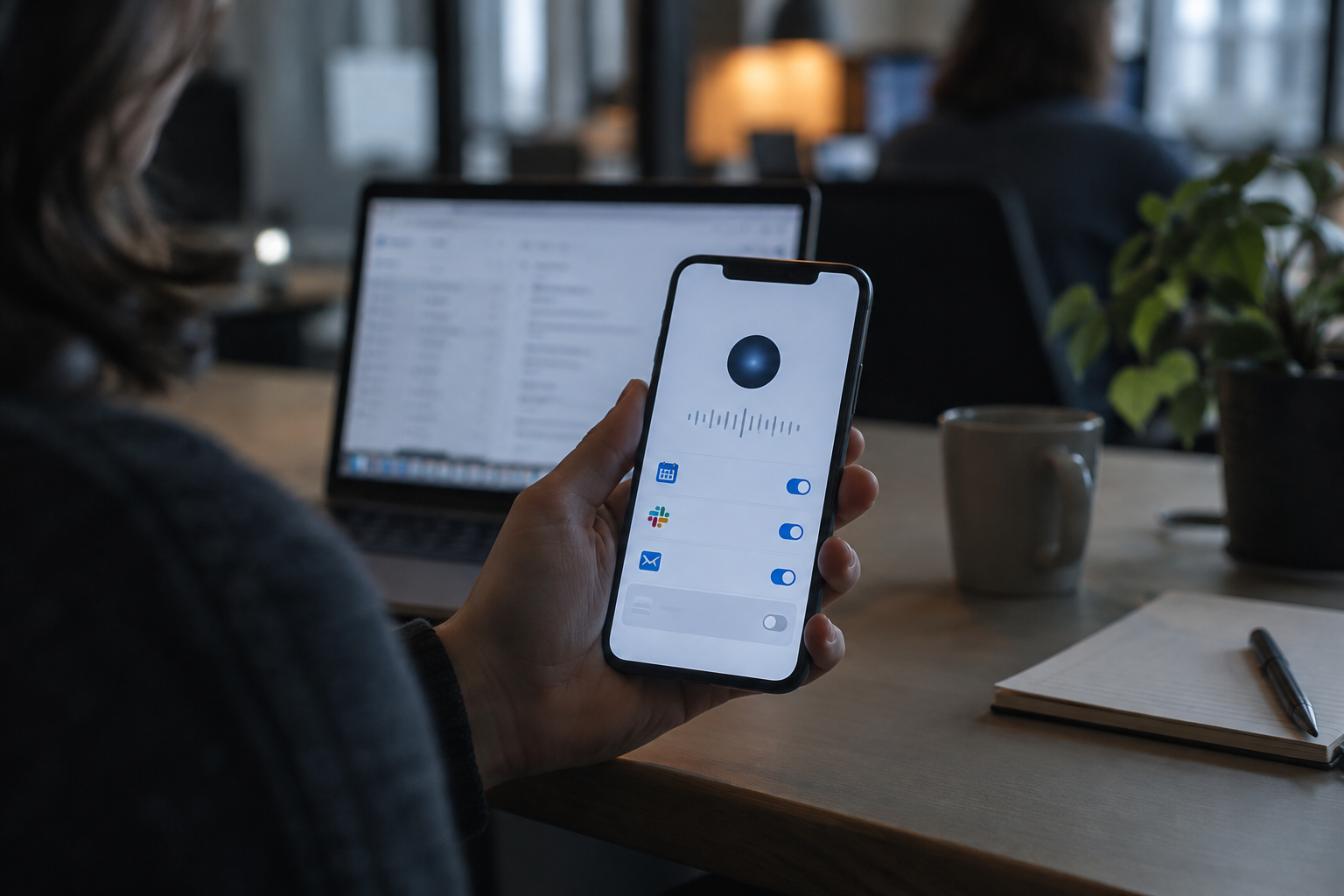
This is not another audio layer that reads Wikipedia entries back to you in a pleasant cadence. OpenAI hooked the audio system directly into live workplace plumbing through an expanded plugin architecture. The tool now has functional read and write access to your email, your calendar, and your company Slack threads.
You do not type a query or copy-paste text between tabs anymore. You speak into your phone or desktop microphone, and the software executes the underlying workflow. It checks scheduling conflicts across your calendar, drafts and sends outgoing emails, and coordinates team threads without touching a keyboard.
The feature also reaches into connected financial applications. In live demonstrations, the system listened to verbal commands, combed through bank accounts and expense histories, spotted recurring billing errors, and initiated cancellations on duplicate subscriptions without human intervention on the banking portal.
OpenAI added creative software development to the voice stack as well. Users can talk their way through spinning up an entire web property, dictating page structure, asset placement, and backend code until the model produces a functional site with an integrated checkout page.
Everyday retail and utility tasks run on the same pipeline. Demonstrations showed the assistant querying localized weather feeds and executing end-to-end online shopping transactions through verbal prompts alone.
All of this runs across the new "ChatGPT Work" tier on both mobile and web clients. Enterprise users can now build text documents, generate visual presentation decks, and structure complex data spreadsheets using purely acoustic inputs while pacing around a conference room.
The rollout is live right now. Anyone running the newest build of OpenAI's application can link their daily software stack and start dictating direct instructions to the machine.
Sam Altman has chased the operating system from Spike Jonze's film Her for years. When OpenAI unveiled its initial ChatGPT Voice interface back in 2024, Altman explicitly referenced the 2013 movie to frame what the lab wanted to construct: an omnipresent, speaking companion that manages human life through conversational audio.
Back then, the voice feature was essentially an audio wrapper around a text-prediction engine. It could hold a rapid, low-latency conversation, mimic emotional inflections, and make people feel less lonely on their evening commute. But it had no hands. It could tell you how to resolve an email argument, but it could not open your inbox to do it for you.
That separation protected corporate IT departments from disaster. As long as voice models lived in an audio sandbox, prompt injection, acoustic hallucinations, and erratic AI behavior had low blast radiuses. An executive could hear nonsense, laugh, and close the application without spilling corporate secrets or wiping databases.
Connecting the stack to third-party plugins changes the equation entirely. When you let an autonomous model operate inside email and internal communications, you remove the human air gap between audio inputs and enterprise data execution.
The underlying horsepower shifted dramatically to make this possible. Swapping out older foundations for the GPT-6 tier—spearheaded by Astra, flanked by the lighter Sol and Luna variants—gives the system enough contextual reasoning to track multi-step workplace assignments across different software environments without dropping thread context mid-sentence.
The moment you give voice AI permission to draft messages and audit billing records, it stops being a conversational novelty and becomes an autonomous workplace operator.
OpenAI structured the GPT-6 family into three distinct operational tiers to handle these workloads efficiently:
OpenAI frames this deployment as the next fundamental evolution in human-computer interaction. The company argues that forcing white-collar workers to click around graphic interfaces, juggle five SaaS tabs, and type manual updates into communication channels is an obsolete computational paradigm that voice agents can completely replace.
Company leadership acknowledges that turning over operating controls to an audio agent introduces brand new failure points. When a model can parse Slack messages and send external correspondence on command, the risk profile of everyday conversational AI changes overnight.
Industry skeptics point to the speed of the deployment across enterprise environments. Handing financial oversight and account cancellation permissions to an automated voice tool raises serious concerns regarding authorization loopholes, inadvertent data deletion, and conversational misinterpretations.
Workers testing ChatGPT Work have expressed immediate amazement at dictating entire spreadsheets and presentation decks from scratch. The productivity gains appear real, but workplace administrators are already wrestling with how to audit decisions made by an assistant whispering through an employee headset.
Competitors in the enterprise software space are watching the plugin integration nervously. If an end user can manage corporate communications, schedules, and digital transactions exclusively through OpenAI's voice layer, traditional enterprise interfaces risk becoming invisible backend pipes.
The immediate battleground will be corporate security policy. Chief information security officers now have to decide whether to permit an Astra-driven audio interface to read proprietary project threads inside Slack and dispatch unvetted emails to corporate clients.
Banking and financial software vendors will face pressure to adapt their verification protocols. If ChatGPT Voice can spot duplicate charges and issue autonomous cancellations, financial institutions will have to build specific verification standards to distinguish between user voice commands and malicious automated prompts.
Competitors will have to match the plugin-connected audio interface quickly or risk ceding the workplace voice market entirely. Running voice models isolated from operational tools like Google Workspace, Microsoft 365, or team messaging apps now looks completely antiquated compared to OpenAI's integrated setup.
The pressure shifts directly onto enterprise workflows. As teams adopt voice-driven document creation and spreadsheet management inside ChatGPT Work, the standard workday will move away from physical typing toward spoken prompt management and rapid oral auditing.
OpenAI will spend the coming quarters managing the fallout from edge-case errors. Allowing an LLM to build live web storefronts and edit transactional systems over spoken audio creates massive opportunities for weird bugs, unexpected billing snafus, and conversational prompt hijacking that text-only sandboxes never had to confront.
Voice AI just crossed the barrier from passive conversational companion to active system administrator. By wiring GPT-6 Astra straight into email accounts, Slack channels, and financial records, OpenAI bypassed the traditional graphical interface. When an assistant can read your messages, fire off emails, and cancel paid subscriptions on your spoken word, voice is no longer an optional accessibility perk. It is the new operating system, and it will force every enterprise security architect to rethink their entire access perimeter.
Reported off The Decoder. Original reporting and analysis by Devon Achebe for Vox Roboti.
The system runs on OpenAI's GPT-6 family, specifically the Astra, Sol, and Luna models.
Yes. The latest update links directly to external plugins for email, calendar, and Slack communications.
Yes. It can scan financial software records, identify duplicate subscription charges, and execute cancellations on your behalf.
It is an enterprise feature enabling users to generate presentations, documents, and spreadsheets on web or mobile purely by speaking.
Yes. OpenAI demonstrated the voice assistant coding an entire website equipped with a functional digital checkout page.
OpenAI rolled out the updated voice system globally in the latest build of its desktop and mobile apps.
Selma Ortiz · 17h ago · 4 min read

Cass Iverson · 2d ago · 5 min read

Selma Ortiz · 2d ago · 5 min read