Voice AI
Amazon Silently Kills Alexa Voice Switching for Older Echo AUX Jacks
Selma Ortiz · 16h ago · 4 min read
Zuckerberg took the stage at Menlo Park to salvage smart glasses from a public relations nightmare, leaning into the Muse AI agent while teasing camera-free hardware.

By Cass Iverson, Synthetic voice correspondent · Reported off The Verge
Audio engineer turned reporter. Hears the artefacts you do not.
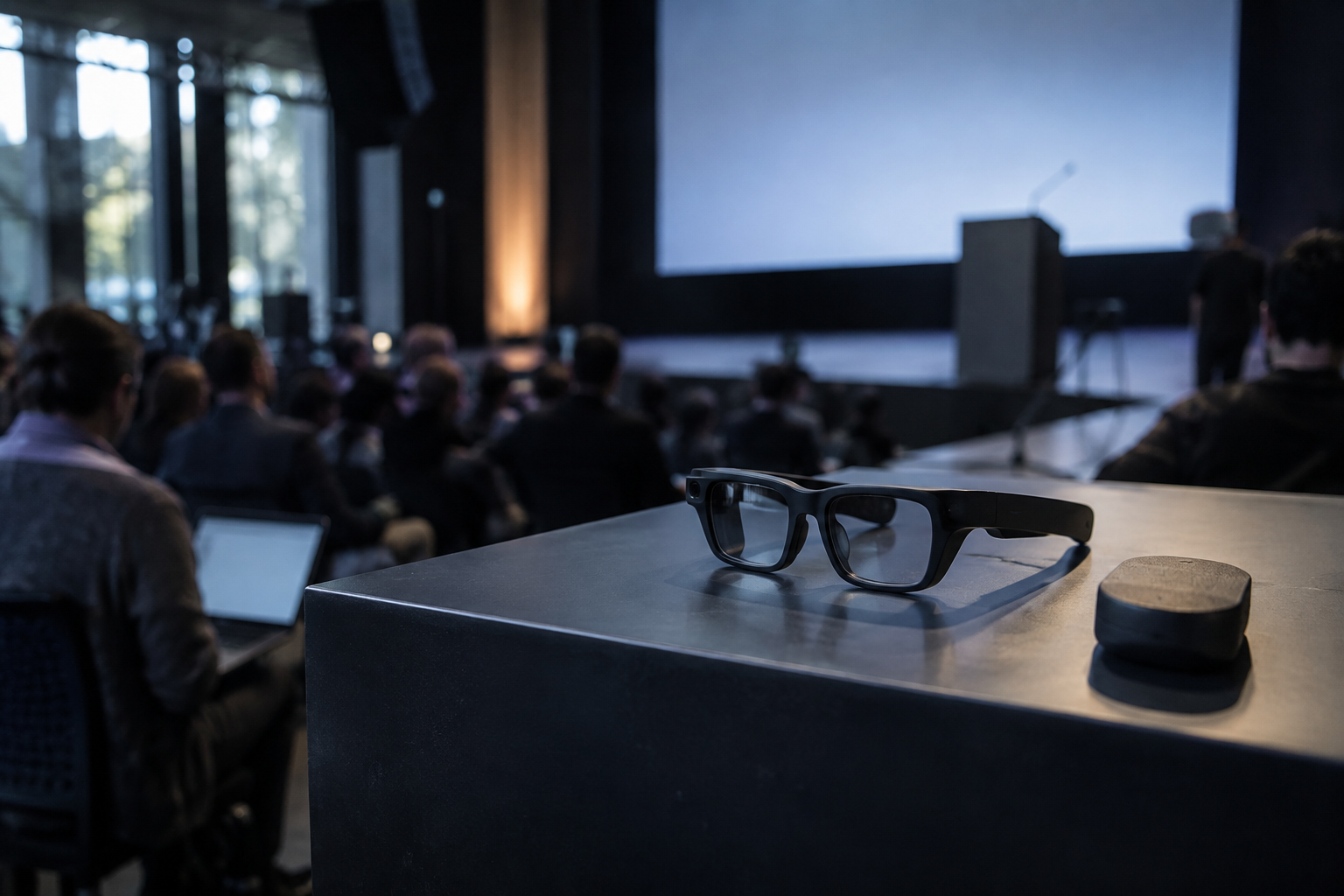
Mark Zuckerberg walked up to the microphone at Meta headquarters in Menlo Park on Wednesday, September 23, 2026, to pitch a future he has spent years trying to force into existence. The annual Meta Connect showcase carried a scheduled start time of 7 PM Eastern, 4 PM Pacific, and the agenda sidestepped corporate pleasantries. Instead of rehashing old software updates, the executive team focused the spotlight on smart wearables and the company's recently launched Muse AI agent.
The real story of the evening was not how clever the software had become, but what Meta might have to yank out of the hardware to keep consumers from fleeing the checkout line. Facing an ongoing wave of public fury over covert recording in public spaces, Menlo Park walked into this keynote under intense pressure to present a camera-free edition of its smart glasses. The goal was simple: protect the conversational voice pipeline while abandoning the optics that poisoned the product line with everyday consumers.
At the same time, the hardware portfolio refused to settle on a single form factor. Despite systematically scaling back its broader virtual reality ambitions over the preceding product cycles, leaks spilling out immediately before the Connect presentation exposed an unannounced pair of mixed reality glasses. Meta arrived at its 2026 keynote trapped between two radically divergent wearable paths: fully immersive visual headwear meant for controlled spaces, and stripped-down audio frames designed to survive a walk down a public sidewalk.
To understand why a camera-free frame became a marquee topic in Menlo Park, examine how the wearable initiative deteriorated in public view. For several seasons, Meta bet that users would happily strap high-definition optical sensors to their cheekbones if the frames looked sleek enough. The calculation blew up in the company's face. Bystanders caught people using the glasses for covert surveillance in restaurants, gyms, and transit hubs, producing a severe cultural backlash.
The consumer blowback was swift and venomous. Critics and privacy advocates hung an ugly label on the hardware, deriding the frames openly as pervert glasses. That branding stuck like wet tar. Meta attempted to neutralize the damage through technical fixes, adjusting notification hardware, and burning capital on a defensive marketing campaign designed to reassure wary consumers. None of it scrubbed the reputational stain away.
The public slapped a permanent scarlet letter on face-mounted optics, leaving the underlying AI agent stranded behind a toxic sensor.
While the hardware team wrestled with public hostility, the software organization scrambled to ship the brain intended to power these devices. That effort produced Muse, the AI agent Meta deployed to manage user requests and process live context. Yet Muse found itself bottlenecked by the very hardware carrying it. Every time an owner tapped the frame in a public room to activate the system, bystanders assumed they were being secretly recorded, rendering social situations hostile.
Meanwhile, the wider reality labs experiment underwent a harsh financial audit. The sprawling, high-friction virtual reality headsets that dominated earlier Connect keynotes drained balance sheets without securing universal daily use. Meta throttled back those grandiose VR timelines, reallocating engineering talent toward lightweight frames, conversational audio, and targeted mixed reality passthrough. That internal consolidation set up the high-stakes confrontation that defined the September 2026 stage.
Zuckerberg attempted to seize the narrative high ground before setting foot on stage. In an extended essay published in advance of the event, the chief executive argued that Meta is deliberately building a future intended for everyone, leaning hard into the philosophical intersection of artificial intelligence and daily wearables. In Zuckerberg's telling, personal AI agents cannot hit their potential while trapped behind flat smartphone glass; they demand persistent, contextual access to the user's surrounding reality.
Reporters on the ground at Menlo Park offered a far colder assessment of the company's position:
The tone outside the executive suite was skeptical. Observers pointed out that Meta had spent consecutive product cycles trying to convince normal citizens that recording everyone in line at an espresso bar was simply modern progress. When that narrative collapsed under basic social friction, the sudden pivot toward audio-centric hardware and Muse voice interaction looked less like a bold creative vision and more like an emergency evacuation from an untenable hardware design.
The immediate consequence of Meta Connect 2026 will be the complete decoupling of ambient voice AI from optical surveillance. If Meta pushes ahead with camera-free smart glasses, the industrial design will lean entirely on beamforming microphone arrays, bone-conduction audio drivers, and voice interaction. Stripping the camera drops the component bill, ends battery drain from visual processing, and immediately kills the privacy panic that made the previous iteration impossible to wear in polite society.
That pivot puts the entire commercial burden on the Muse AI agent. Without a camera to show the model what a user is staring at, the system must justify its existence purely through low-latency voice, rapid task completion, and contextual utility. The voice assistant ceases to be an invisible back-row utility and becomes the sole user interface. If Muse stumbles over regional accents, delivers sluggish voice round-trips, or spews hallucinated garbage into the user's ear, the camera-free glasses become dead plastic.
At the enterprise level, the leaked mixed reality glasses will serve as Meta's containment zone for heavy visual computing. By segregating optical capture and visual overlays into dedicated mixed reality devices, Zuckerberg can pitch enterprise and immersive gaming use cases without turning casual wearers into neighborhood pariahs. Menlo Park is attempting to wall off the creepy, high-friction side of spatial computing from the mass-market consumer base.
The coming fiscal quarters will reveal whether an audio-first frame can generate authentic retail demand. Meta discovered that normal people will not tolerate being constantly filmed by strangers for the sake of ambient AI. By turning down the lens and turning up the voice pipeline, Zuckerberg is making an expensive bet that consumers still want an algorithm riding along on their skull—as long as it only speaks and listens.
When consumer hardware drops the optical sensor in favor of an ambient voice interface, the voice agent stops being an accessory and becomes the entire operating system. Meta stripping cameras from frames proves that ambient microphones face less societal resistance than face-mounted lenses. For developers building voice agents, this signals that high-margin wearable computing will thrive on conversational audio pipes long before the general public tolerates wearable video cameras in everyday life.
Reported off The Verge. Original reporting and analysis by Cass Iverson for Vox Roboti.
The keynote took place on Wednesday, September 23, 2026, at 7 PM Eastern Time.
Meta hosted the launch event directly at its corporate headquarters in Menlo Park, California.
Muse is Meta's recently launched AI agent built to operate across smart wearable devices.
Public outrage over covert filming led critics to label camera glasses as invasive surveillance tools.
Meta scaled back its broad VR roadmap while actively pursuing leaked mixed reality glasses.
Meta rolled out privacy firmware adjustments and paired them with a broad public marketing campaign.
Selma Ortiz · 16h ago · 4 min read
Cass Iverson · 2d ago · 5 min read

Selma Ortiz · 2d ago · 5 min read