Voice AI
Amazon Silently Kills Alexa Voice Switching for Older Echo AUX Jacks
Selma Ortiz · 15h ago · 4 min read
Google is wiring Gemini straight into Android Auto with access to your emails, photos, and calendar. Just don't expect it to work in Europe.

By Ray Dalton, Editor-in-chief · Reported off Google Blog
Runs the desk. Allergic to demos that only work on stage.
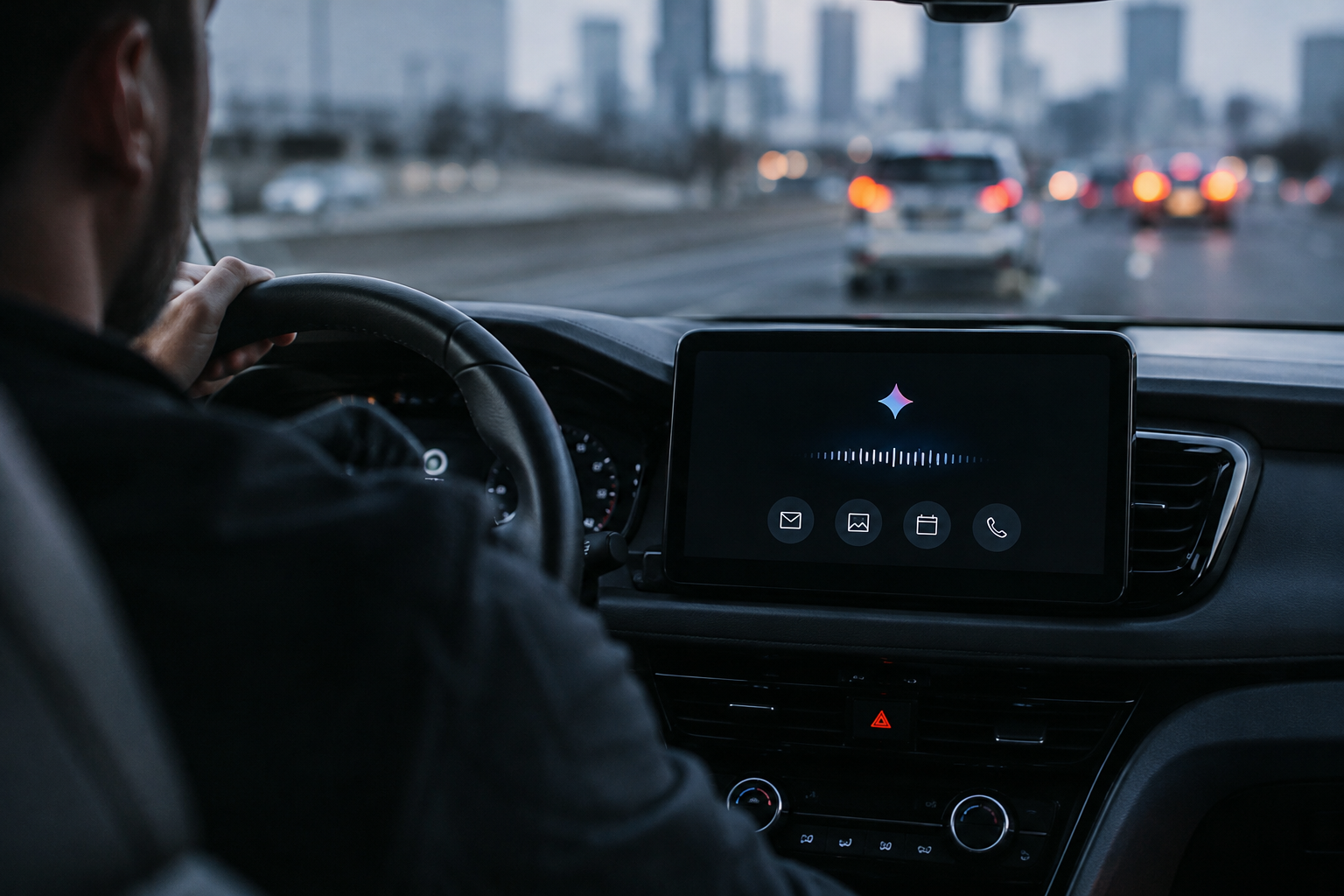
Google just turned your dashboard into an intelligence analyst with unfettered clearance to inspect your personal life.
On October 20, 2026, the company launched Personal Intelligence for Gemini inside automotive cabins worldwide. Senior Product Manager Karan Daryanani confirmed the release, moving the capability directly into Android Auto immediately, with native integration for cars running Google built-in slated for the following months. This is not another reskinned voice command dialer designed to tune FM radio stations or fumble through contact lists. Google wired its flagship neural model directly into Gmail, Google Calendar, Google Photos, Google Maps, YouTube, and standard web Search. The agent sits between the steering wheel and the driver, pulling contextual threads across private services to resolve queries without touch input.
Driving demands total visual focus, yet modern life fragments critical logistics across disconnected corporate software silos. Daryanani's team built this deployment around dual operational competencies: targeted data retrieval from private repositories and contextual reasoning across disparate operational sources. Instead of forcing a commuter to park on a highway shoulder to cross-examine digital receipts, the system connects logistical dependencies autonomously. A driver heading toward an airport terminal can ask for their flight gate and schedule status simultaneously. The model reads the confirmation token inside Gmail, checks live airline flight boards through Search, and serves the synthesis through the car speakers in a single voice response.
The agent pulls private data across Google's entire ecosystem to answer complex driving questions without forcing you to tap a screen.
Contextual parsing extends beyond text correspondence into unstructured personal media archives:
Every functional scenario hinges on eliminating manual interaction cycles at high speeds. The passenger compartment is historically hostile to complex query trees, but Google is betting that deep system integration solves what basic speech-to-text interfaces broke.
Automotive software has spent fifteen years trapped in an awkward transitional ditch. Drivers entered modern vehicles with supercomputers in their pockets, only to encounter dashboard consoles that operated like glorified 2004 navigation units. First-generation voice platforms relied on rigid, rule-based command grammars. If you mispronounced an artist's surname or swapped the syntax of a navigation prompt, the dashboard threw a syntax error or placed a phone call to the wrong relative.
Alphabet previously addressed this friction through Android Auto projection and its subsequent operating layer, Android Automotive OS, commercialized as Google built-in. Major global automakers, including Volvo, Polestar, General Motors, and Honda, began stripping proprietary telematics stacks out of their vehicle lines to install native Google architectures. Those cabins ran Google Assistant, a legacy speech engine built on intent classification and deterministic voice routing pipelines. Assistant could adjust cabin temperature, map a route down an interstate, or read an SMS payload aloud. It could never synthesize information across decoupled personal software applications.
At the same time, the broader technology industry shifted toward generative model architectures capable of semantic deduction. Google spent 2024 and 2025 dismantling the architectural boundaries separating standalone mobile applications, enterprise productivity suites, and its core Gemini models. The automotive deployment represents the logical, aggressive extension of that cross-platform convergence. The vehicle dashboard is no longer treated as an isolated audio accessory. Google now views the car as an active ambient client, demanding the same unified reasoning layer deployed on mobile hardware and personal computing displays.
Reaction to the rollout splits cleanly along lines of operational utility and digital containment. Product leads inside Mountain View frame the release as a critical safety evolution, arguing that context-aware natural language minimizes cabin distraction by killing visual interface dependence entirely. Drivers no longer fiddle with mounted smartphone touchscreens to find missing flight notifications or locate street numbers embedded in work calendars.
Privacy engineers and digital rights advocates take a significantly more skeptical stance toward Google wiring enterprise and consumer communications channels directly into automotive infotainment hubs. When an in-dash AI can search your personal snapshot gallery and read your daily inbox while you merge onto a turnpike, the boundary between logistical utility and ambient surveillance evaporates. The company knows this line of attack well, which is why Daryanani spent half the launch documentation outlining strict operational parameters.
Personal Intelligence requires explicit, manual user opt-in before touching local or cloud-stored account databases. Users retain the operational option to sever specific application hooks within their root Gemini preferences at will. Furthermore, vehicles operating native Google built-in telematics will strictly withhold personalized spoken telemetry unless the authorized personal handset is detected inside the vehicle cabin. If an unauthorized guest borrows the keys, the vehicle treats the driver as an anonymous operator. General navigation, phone operations, and audio media streaming function normally, but the agent refuses to pull personal calendar items or parse private emails.
Then there is the regulatory blockade. Google explicitly barred major portions of the global population from accessing this software at launch. Personal Intelligence is restricted to consumer accounts owned by users aged eighteen and older, completely excluding corporate Workspace, business enterprise, and educational account holders. More tellingly, Google categorically blocked the rollout across the European Economic Area, Switzerland, the United Kingdom, and Nigeria. Regulators in Brussels and London have made it excruciatingly clear that cross-service personal data ingestion by dominant platform gatekeepers triggers intense anti-monopoly and data protection scrutiny under the Digital Markets Act and General Data Protection Regulation. Mountain View decided that dodging regulatory fines in Europe was preferable to fighting European watchdogs over in-car inbox crawling.
The immediate fight now shifts from platform design to automotive hardware deployment. Android Auto users receive initial operational access immediately through connected mobile software updates, but the rollout across Google built-in vehicles will stretch quietly across the coming months. That latency exposes the fundamental problem Google faces in automotive markets: vehicle software integration moves at the pace of heavy manufacturing, not agile mobile development.
Detroit and European car manufacturers maintain deep skepticism regarding Google's long-term dashboard dominance. General Motors made waves by announcing plans to phase out smartphone projection systems entirely, betting instead on captive software revenue pipelines. Yet Google's rollout illustrates the trap facing independent car makers. No automotive brand possesses the engineering capital to build a custom neural agent that indexes a driver's private inbox, personal photo gallery, and schedule in real time. If drivers demand intelligent cabins that know their personal schedules, automakers will have no choice but to license Silicon Valley operating software.
Apple remains the immediate counterweight, but Cupertino's extended delay in commercializing next-generation CarPlay has given Google valuable open tarmac. If Gemini delivers reliable, hallucination-free route and schedule execution across Android Auto vehicles this quarter, Google cements a dominant consumer software moat inside the automotive space. If the system hallucinates navigation routes or misreads private email chains while drivers are traveling at highway velocities, the backlash against ambient in-car computing will be swift, public, and brutal.
The modern dashboard is no longer just a screen mirror for your smartphone. It is becoming an ambient intelligence outpost. By granting Gemini direct clearance to cross-reference personal emails, photo libraries, and navigational histories, Google is forcing a brutal standard on the automotive industry. Carmakers trying to build proprietary infotainment ecosystems cannot compete with an AI that already knows what is inside your inbox. You either let Google run the software inside your vehicle, or you sell your customers an empty dashboard that feels broken the moment they sit down.
Reported off Google Blog. Original reporting and analysis by Ray Dalton for Vox Roboti.
It is an in-car AI feature allowing Gemini to pull data from personal Google accounts to answer complex driving questions.
Gemini links directly with Gmail, Google Calendar, Google Photos, Google Maps, YouTube, and Google Search.
Yes. Drivers can ask Gemini to extract location data from an image in Google Photos and launch turn-by-turn navigation.
Google excluded the European Economic Area, the UK, and Switzerland from launch due to regional regulatory and privacy compliance requirements.
No. The system strictly excludes Google Workspace business, enterprise, and educational accounts at launch.
Cars with Google built-in only expose personal responses when your verified smartphone is physically connected inside the vehicle.
You can opt out or disable access to specific Google applications anytime within your mobile Gemini settings menu.
Selma Ortiz · 15h ago · 4 min read

Cass Iverson · 2d ago · 5 min read

Selma Ortiz · 2d ago · 5 min read