Voice Agents
Meta Hands Muse AI an Animated Face and Opens Real-Time Video Calls Across the US
Nina Falco · 3h ago · 5 min read
Aina's $399 smart ring packs a screen, microphone, speaker, and analog stick to run voice agents from your knuckle. Here is why hardware makers want AI off your phone.

By Nina Falco, Front-desk beat reporter · Reported off TechCrunch AI
Sold answering services to dentists. Now she reports on them.
Hardware startups spent two years telling you to wear pins on your shirt or carry orange plastic squares in your pocket. Both crashed on contact with reality. Now, Aina wants to put the command deck for your voice agents directly on your index finger.
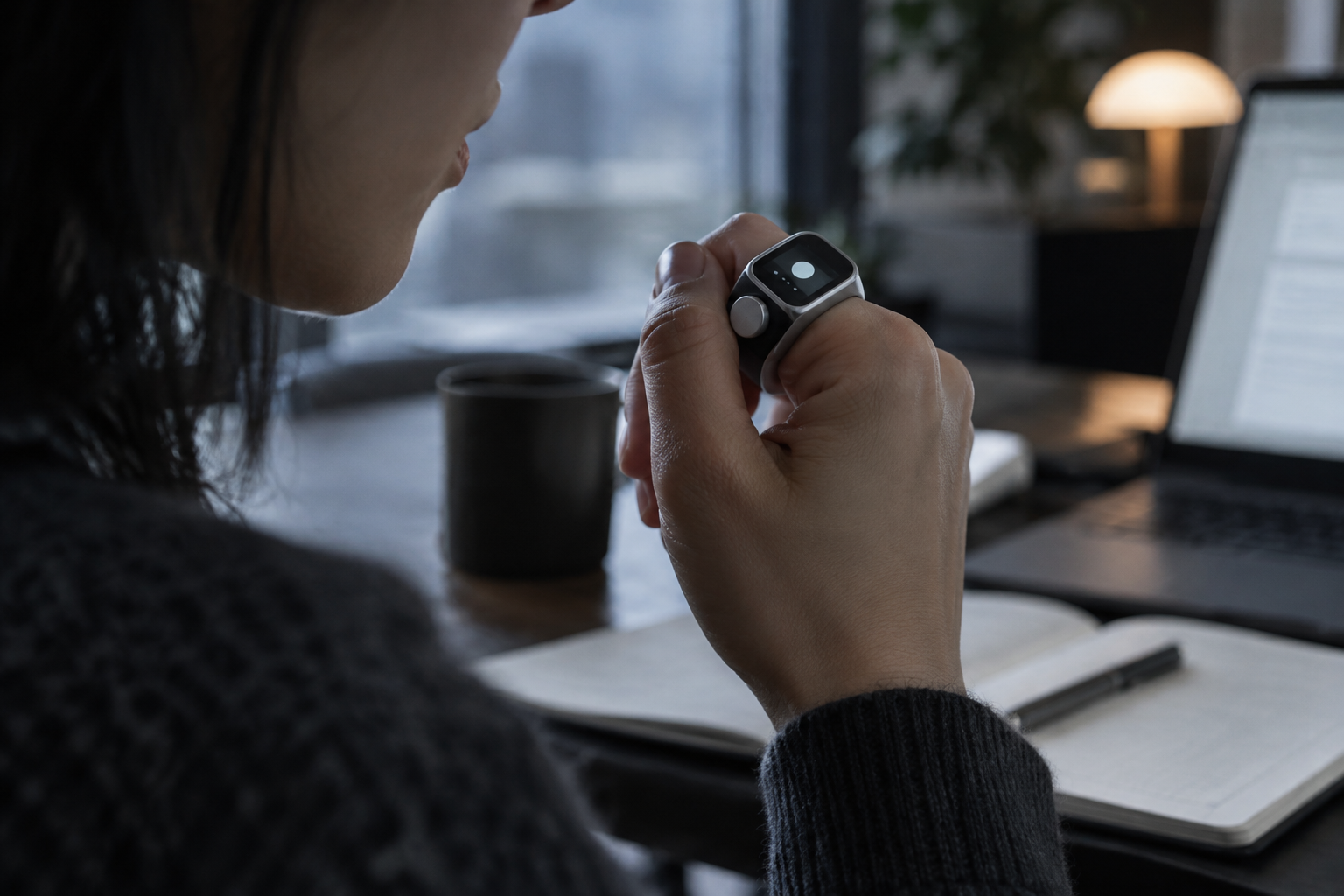
The startup unveiled its new smart ring on Thursday, November 5, 2026, slapping an introductory $399 price tag on pre-orders. When that early batch closes, the retail sticker climbs straight to $499. For that money, Aina is cramming an absurd amount of hardware into a wearable cylinder: a miniature display screen, a mechanical micro-joystick, gesture sensors, a speaker, and an onboard microphone.
This is not a passive fitness band built to track your sleep stages while you ignore its charts. Aina calls the gadget simply the AI ring, designing it as an active peripheral to command software agents across desktop and mobile operating systems. You press the input, speak into the mic, and route prompts straight to automated workflows without pulling a phone from your pocket.
The audio pipeline works in both directions. The onboard microphone captures dictation, transcribing speech through either Aina's proprietary voice engine or Wispr Flow on connected Mac computers. Because the chassis houses a miniature speaker, the ring also takes standard voice calls and plays back synthesized responses from background agents.
Physical inputs take over when voice commands make no sense in public. The tiny joystick lets you flick through interface elements, while the screen shows incoming notifications, active software controllers, and meeting alerts. Users can summon an Uber ride, control music playback, or navigate television menus on an Apple TV through local gestures.
Pre-orders opened immediately on November 5, with initial hardware units scheduled to leave the factory for customer doorsteps in January 2027. Aina is banking on early adopters paying five hundred dollars to stop reaching for their keyboards.
Aina did not start inside the jewelry business. The startup previously built Mirage, a specialized Mac peripheral armed with three mechanical keys. Mirage sat next to keyboards to hijack desktop workflows, letting users toggle cameras, silence microphones, or abandon Google Meet calls with a single physical tap.
Mirage gave the company hard telemetry on how knowledge workers interact with desktop tools. It also convinced investors to open their checkbooks. In July 2026, Aina closed a $5.5 million funding round to transition its context-aware input model from a desk toy into wearable form.
Moving to the finger puts Aina inside a crowded hardware corridor. Smart rings have multiplied over the past three years, but almost all of them treat voice as an afterthought. Devices like the Pebble Index 01, the Sandbar Stream, the Oasis, and the Natura have carved out small niches by focusing on quiet biometric tracking or simple vibration nudges.
None of those existing rings dared to bolt an interactive display, an analog stick, and an audio speaker onto the same band. Most hardware engineers run away from that design because audio drivers and optical panels butcher wearable battery cells. Aina ignored that consensus, choosing instead to build a shrunken smartwatch that wraps around a finger.
They are not the only outfit convinced that generative tools require weird new controllers. Rabbit tried to pitch its standalone handheld as an agent intermediary before its software evaporated under scrutiny. OpenAI has spent months toying internally with experimental keyboard prototypes designed to orchestrate background models. Aina is betting the finger beats the desk.
Aina's leadership argues that standard consumer operating systems are fundamentally broken for an era dominated by proactive software models.
"Phones and laptop screens were designed for an age of browsing where you think about opening apps. For interacting with proactive agents, we need a better interface, and that is what we had in mind while designing Aina." — Apoorv Shankar, Founder of Aina
Shankar's pitch hinges on the friction of modern user interfaces. Unlocking a phone, swiping past notification banners, finding an application icon, and waiting for an input field takes six seconds. Speaking a command into an open audio channel takes one. Aina wants the ring to act as the steering wheel for autonomous software that works without constant app switching.
Early hands-on tests reveal a device caught between brilliant convenience and sheer hardware overreach. Reviewers report the unit handles meeting alerts smoothly, picks up speech cleanly for dictation, and successfully manipulates Apple TV playback when the physical remote goes missing in the couch cushions. The ring surfaces incoming calendar appointments and lets users fire off quick voice replies without glancing at a laptop.
Yet early testers also note the software remains half-baked. When an operating system tries to predict which Mac app you want to manipulate based on screen state, it occasionally guesses wrong. The micro-joystick requires delicate thumb precision, and talking to your hand in an open-plan office still makes you look like an extra in an eighties spy movie.
Engineers tracking the wearable space remain skeptical about the physics. A ring that constantly listens for mic prompts, runs a screen, and drives a voice speaker faces brutal power constraints. If the battery dies in four hours, nobody cares how smart the dictation engine is.
The road between a November announcement and a January 2027 shipping window is paved with broken hardware promises. Aina has less than three months to stabilize its companion firmware and prove its manufacturing line can package micro-speakers, displays, radios, and joysticks into comfortable metal shells at scale.
Once devices ship, the startup faces a pricing wall. Selling a ring for $399 to gearheads during an early-bird push is relatively easy. Convincing mainstream users to pay the full $499 retail price requires software that works flawlessly every single hour of the day. If the companion app drops Bluetooth pairing or garbles agent prompts, the ring becomes an expensive paperweight.
The broader bet relies on developers actually building multi-agent workflows worth controlling. Right now, most white-collar workers use one text prompt window at a time. Aina's entire thesis depends on a future where knowledge workers juggle three, four, or five background agents running simultaneously for research, email drafting, scheduling, and code generation.
If that autonomous future arrives, users will demand an ambient control pad that bypasses clumsy mobile app grids. If it stalls, Aina has built a five-hundred-dollar remote control for an Apple TV and a Google Meet mute button you wear to dinner. We find out which one it is when the first boxes land in January.
The voice interface war is leaving phones behind. Smart assistants died inside mobile app drawers because opening a phone to speak to an agent creates friction that ruins the experience. Hardware startups now realize that proactive agents need instant, body-worn audio access. If Aina can make a mic, speaker, and joystick survive on a ring battery, it exposes the smartphone screen as an outdated middleman for speech-driven workflows.
Reported off TechCrunch AI. Original reporting and analysis by Nina Falco for Vox Roboti.
It is a smart ring packing a microphone, speaker, display, and joystick to command software agents and dictate text.
Pre-orders start at $399 for early buyers. The retail price jumps to $499 once the early-bird window closes.
Aina plans to begin delivering the first production batch to pre-order customers in January 2027.
Yes. The ring includes an internal speaker and microphone, allowing users to conduct phone calls from their finger.
Voice capture routes through Aina's custom speech engine or connects directly to Wispr Flow on an Apple Mac.
The ring handles music, summons Uber rides, manages Mac notifications, and operates smart home devices like Apple TV.
Nina Falco · 3h ago · 5 min read

Devon Achebe · 1d ago · 6 min read

Nina Falco · 7d ago · 5 min read