
Voice AI
Nothing Ear Note Puts Conversational AI in Your Ears and Your Pocket
Ray Dalton · 19h ago · 5 min read
Surrey's police commissioner demoed her own synthetic voice clone to prove a point: automated voice fraud is running rampant, and three seconds of audio is the new skeleton key.

By Tobias Reinholt, Policy and security writer · Reported off BBC AI
Fraud analyst turned policy writer. Deepfakes, consent, regulators.
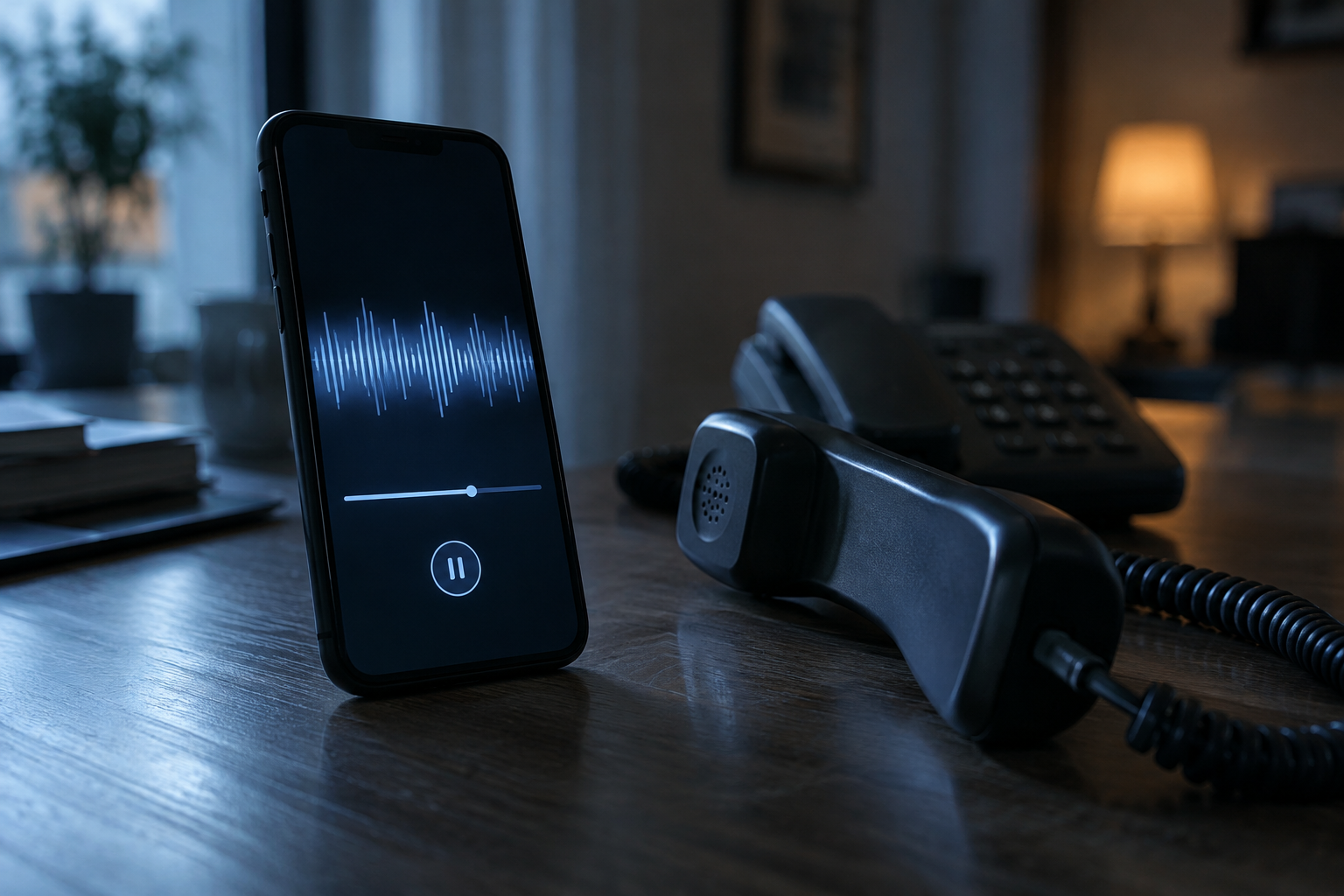
Three seconds. Count them out. One, two, three. That is the entire audio sample a criminal needs to clone your vocal identity, load it into an automated speech model, and ring your parents to demand cash.
Lisa Townsend, the Police and Crime Commissioner for Surrey, proved that point by playing an artificial replica of her own speech to the public. She staged the demonstration to expose how cheap, commoditised audio cloning has shifted from an experimental oddity into a front-line consumer shakedown. The timing was deliberate: bad actors ramp up extortion campaigns as the winter holidays approach, banking on distracted families, holiday spending spikes, and harried relatives who do not pause to verify who is actually speaking on the line.
Townsend took her demonstration to the airwaves of BBC Radio Surrey to break down the mechanics. The process no longer requires high-end studio recordings, hours of source stems, or custom phonetic datasets. A scammer scrapes a three-second snippet of clear audio from an Instagram story, a TikTok video, a podcast appearance, or even an outgoing voicemail message. They feed that sample into a consumer-grade diffusion model or neural voice synthesiser. Within moments, the software spits out arbitrary sentences tuned to the victim's pitch, timbre, accent, and natural inflection.
The resulting synthesized voice can then be weaponized across whatever hardware pipeline is handy. The police commissioner warned that the assault is not confined to shady websites or encrypted chat applications. The calls cut across every communications channel available to the modern household: cellular devices, desktop VoIP setups, standard personal computers, and legacy copper landline networks.
We know that criminals are absolutely capable and willing to exploit new technology. It is online, it is on your mobile phone, it is coming through your computers, and sometimes it is coming from your landline.
This is not speculative fiction. The economic damage from mass-market deception is already staggering. Fresh figures released in June from the UK Finance annual report reveal that criminals stole £1.3 billion through fraud operations during 2025. This was not a handful of unlucky high-net-worth targets losing their shirt on elaborate corporate wire scams. The organization tracked over four million individual fraud cases where victims lost cash across the exact same reporting period.
The growth curve shows no sign of levelling off:
That 31 percent escalation over a two-year window matches the exact period in which real-time zero-shot voice cloning moved from academic white papers to cheap commercial API tiers and open-source GitHub repositories. While software startups competed to cut inference latency down to sub-200-millisecond thresholds for enterprise support agents, bad actors realised they could automate social engineering.
Legacy anti-fraud playbooks relied on clear red flags. If a text message arrived riddled with broken English, misspelled banking domains, or bizarre syntax, an alert target ignored it. If a call came from an unfamiliar international code, people hung up. Speech synthesis removes the telltale signs of digital deception. A victim is no longer evaluating a suspicious email template; they are listening to what sounds like their son sobbing about an emergency legal fee, their employer issuing an urgent transfer instruction, or a council official demanding an unpaid levy over the landline.
Inside the shopping malls and transit hubs of Surrey, the public is waking up to the reality that common sense is no longer a sufficient defense against neural audio spoofing.
At the Friary Centre in Guildford, shoppers spoke about the shifting operational profile of incoming phone calls. Enid Jones, a local resident interviewed on BBC Radio Surrey, admitted that while she believed she had a solid understanding of basic safety precautions, the sheer sophistication of modern schemes has undermined that confidence. The telltale indicators that worked five years ago do not help when the voice on the other end carries the identical cadence and tonal imperfections of an immediate family member.
Victoria Oso, a mother of two who was also speaking in Guildford, laid out the psychological trap that synthetic voice operators exploit every single afternoon. She observed that when a parent is overwhelmed, sleep-deprived, or managing household chaos, their ability to conduct a methodical security audit goes out the window. Criminals do not need a flawless acoustic reproduction to succeed; they only need a synthetic clone that is convincing enough to short-circuit a stressed parent's skepticism for thirty seconds.
Townsend herself stressed that vulnerability is not a character flaw or an issue of low digital literacy. Anyone can be broken under the right conditions. When a caller manipulates emotional urgency, adds ambient background noise, and pairs it with the authentic timbre of a loved one in distress, human biology takes over. Logic takes a backseat to adrenaline. The target opens their banking application, approves the transfer, and discovers the deception hours after the money has vanished into money mule networks.
Townsend's public warning is an attempt to erect a psychological firewall before holiday commerce enters full swing. But warnings without operational changes will not move the needle against automated voice syndicates.
First, reliance on unverified inbound calls has to end. The telecommunications infrastructure across Britain was built for an era when an audio stream carried implicit proof of human identity. That era is dead. If an incoming caller asks for a financial transaction, an emergency wire, or credential validation, the only safe response is an immediate hang-up followed by an out-of-band call to an established, pre-saved number.
Second, families are being forced to adopt security practices straight out of corporate espionage manuals. Household safewords and shared verbal authentication phrases—pre-agreed code words never written in digital chats, social profiles, or emails—are becoming the baseline countermeasure against three-second clone engines. If the voice on the phone claiming to be your daughter cannot provide the family passkey, the call terminates on the spot.
Third, telecom providers face growing pressure over their dumb-pipe posture. Voice transport layers currently route synthetic traffic from spoofed numbers directly into domestic mobile and landline receivers without running deepfake detection or origin-validation checks. As losses push well past £1.3 billion annually, regulators will stop treating phone networks as neutral carriers and start demanding active acoustic screening on incoming streams.
Until that carrier-grade infrastructure arrives, the burden remains on the person holding the handset. Every public audio recording you have ever posted online is now an available training set. When the phone rings this season and the voice on the line sounds familiar, keep your hands off your banking app until you prove there is an actual human being on the other end.
The era of trusting acoustic reality over the phone is officially finished. When three seconds of random social video gives any petty criminal a flawless voice disguise, voice is no longer an authentication layer; it is an open attack surface. The speech tech industry spent five years racing to make voice cloning frictionless, instant, and cheap. Now that tech is bleeding normal citizens for £1.3 billion a year, enterprise voice agents, telecom backbones, and authentication providers are going to face a brutal regulatory reckoning on who pays for the fallout.
Reported off BBC AI. Original reporting and analysis by Tobias Reinholt for Vox Roboti.
Scammers need only three seconds of clean source audio to generate a working synthetic model that speaks in full sentences.
UK Finance reported that criminals stole £1.3 billion through scams during 2025 across more than four million documented cases.
Fraud cases involving stolen money grew 11 percent between 2024 and 2025, and increased 31 percent compared to 2023 totals.
Surrey Police and Crime Commissioner Lisa Townsend issued the warning and demonstrated the danger using an AI replica of her own voice.
Criminals deploy synthetic voice attacks across mobile phones, computers, internet channels, and traditional landline numbers.
Scammers exploit holiday stress, financial pressure, and distraction, catching people off guard when they are emotionally vulnerable and rushed.
Attackers harvest snippets from public online recordings, social media videos, voicemails, and digital broadcasts without the owner knowing.
Hang up immediately and call back on an established, trusted phone number, or demand a pre-arranged family verbal safeword.
Ray Dalton · 19h ago · 5 min read

Cass Iverson · 4d ago · 6 min read