Voice AI
Ray-Ban Meta Gen 3: Voice Upgrades Stumble Over a $529 Price Tag
Cass Iverson · 4d ago · 6 min read
Carl Pei scrapped smart glasses to put voice transcription into earbud cases. The Nothing Ear Note lands December 8, turning everyday audio gear into an always-ready meeting recorder.

By Ray Dalton, Editor-in-chief · Reported off The Verge
Runs the desk. Allergic to demos that only work on stage.
You do not need another screen. You certainly do not need an orange plastic box hanging off your lapel or a laser projector scorching your palm. The standalone AI hardware experiment hit a wall, and Carl Pei noticed.
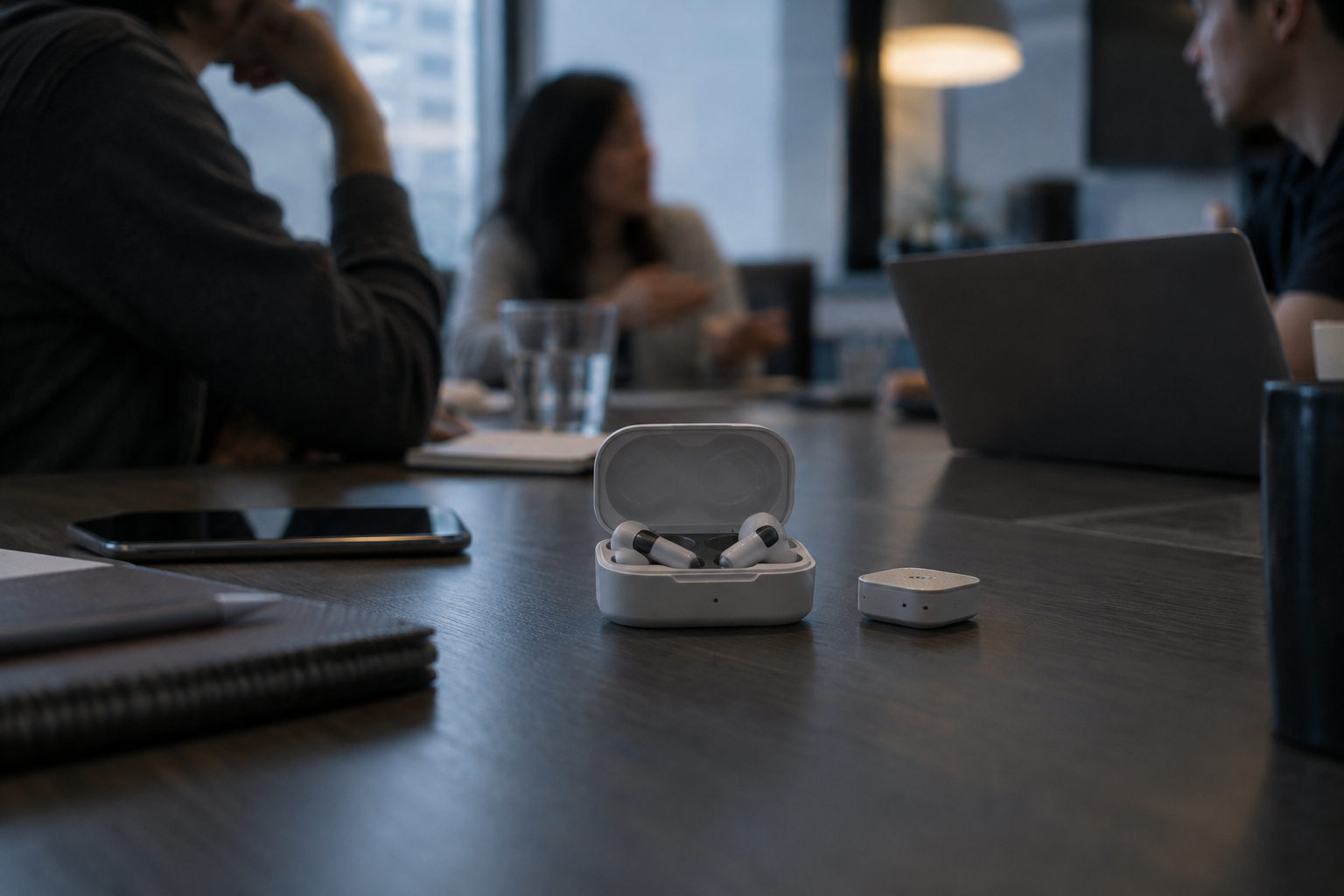
On November 23, 2026, Bloomberg revealed Nothing's next piece of hardware: the Ear Note. It looks like standard personal audio. It behaves like an ambient stenographer. Instead of demanding a fresh spot on your body, Nothing built an audio recorder and transcription engine directly into a pair of wireless earbuds and their battery case. Pei demonstrated the prototype himself ahead of a planned rollout on December 8, showing off a dual-mic architecture that captures speech from your head or from the palm of your hand.
The Ear Note splits its acoustic intake between the earpieces and the charging housing. You can leave the buds seated inside the shell, set the box on a boardroom table, and press a physical Talk button on the chassis to log a discussion. Microphones embedded directly into the case handle ambient room pickup, while internal microphones handle spoken audio when the buds are lodged in your ears.
A companion mobile application pulls the raw audio files, runs speech-to-text processing, and outputs readable transcripts alongside automated summaries. Nothing designed the software layer to interface with external AI agents while maintaining an in-house voice-control framework for local operations. That proprietary voice stack lets wearers initiate bidirectional spoken exchanges without reaching for a phone screen.
Nothing confirmed the December 8 launch date but withheld retail pricing during the demonstration. The company is actively testing market tolerance for AI-branded peripherals after watching first-generation voice pins struggle to find recurring buyers.
Hardware makers spent two years trying to convince consumers to adopt bizarre, screenless form factors. Most failed. Humane burned through massive venture rounds trying to sell a magnetic badge. Rabbit pushed a motorized camera toy that ran basic scripts through cloud servers. Both missed the obvious reality of consumer behavior: people already carry microphones in their ears every single day.
Nothing started laying the groundwork for this pivot across its 2026 audio catalog. Earlier in the year, the firm rolled out an Audio Snapshot utility for the budget-tier Ear 3A, testing how users managed quick voice memos on the go. Before that, the flagship Ear 3 introduced a chassis-mounted Talk button, letting users initiate voice logs without fumbling with touch-sensitive stems. The Ear Note takes that hardware lineage and wires it straight into automated text summaries.
Pei also cleared the deck internally to make this happen. Nothing postponed its anticipated AI smartwatch and shelved early research into smart glasses. Instead of scattering engineering talent across unproven wearable categories, the team committed to an aggressive smartphone launch roadmap for 2027 while using audio accessories as the immediate beachhead for voice computing.
They are not alone in the ear-level recording race. Anker already shipped the Soundcore Liberty 5 Pro Max, which also packs case-level recording triggers and exports generated transcripts into an app. Apple pushed voice capture deeper into watchOS and iOS, and Amazon rolled out its Bee ambient recorder to test workplace logging. The difference sits in how Nothing packages the interaction.
"Rather than ask you to carry a new product, we took something you already wear and trust and made it intelligent."
Pei posted that explanation to X shortly after the demonstration went live. He framed the Ear Note as the foundation of an ambient context layer, arguing that utility wins when it piggybacks on existing habits rather than forcing new ones.
Hardware analysts tracking peripheral margins see the move as a practical hedge. Selling a dedicated voice recorder to mainstream buyers is nearly impossible; selling noise-canceling earbuds with automated meeting minutes is an easy corporate expense. The hardware ecosystem breaks down into three distinct approaches to consumer voice capture:
Critics point out that case-based recording creates immediate friction in professional settings. Placing an unbranded tech shell in the middle of a private briefing raises immediate consent questions. Anker avoided public pushback only because its transcription tools flew under the radar of enterprise compliance officers. Nothing, with its high-visibility design language, will face harder questions about how audio leaves the charging case and where remote models process sensitive corporate dialogue.
Inside developer circles, attention is focused on Nothing's hybrid software model. Rather than locking the Ear Note to a single corporate ecosystem like Siri or Google Gemini, the company built the device to route spoken input to multiple competing AI agents while preserving its own lightweight voice engine for fundamental hardware commands. That split keeps latency low for volume adjustments and track skips while offloading complex reasoning to cloud-based large language models.
The immediate test arrives December 8 when Nothing attaches a dollar figure to the hardware. If the company prices the Ear Note in line with its traditional sub-$150 audio portfolio, it undercuts dedicated workplace transcription gadgets overnight. If Pei attaches a recurring subscription fee for cloud summarization tokens, consumer enthusiasm will hit a wall.
The broader hardware roadmap points toward a tightly integrated phone ecosystem in 2027. By using the Ear Note to collect acoustic context and voice commands throughout the day, Nothing builds a functional data layer for its upcoming handsets without having to manufacture experimental AR spectacles or bulky smart rings. The earbuds gather the intent; the phone runs the heavy compute.
For voice developers, this shift signals where real-world usage will actually live. People do not want to talk to their lapels or whisper into rings. They speak through Bluetooth earpieces while pacing hotel lobbies, driving cars, and sitting in client reviews. By adding dedicated mics to the charging case, Nothing solved the battery and social penalty of keeping plastic plugged into your ear canal all afternoon. You drop the case on the desk, tap the shell, and let the voice model take the notes. Whether business executives allow that blinking case into closed-door salary negotiations is another problem entirely.
The standalone AI gadget is dead. Lapel pins and plastic handhelds failed because consumers refuse to carry single-purpose novelties. By baking ambient microphones, transcription, and agent voice pipes directly into an earbud case, Nothing validates the real home for consumer voice AI: existing audio accessories. It turns mundane Bluetooth gear into a context-aware voice layer without demanding a new wearable habit.
Reported off The Verge. Original reporting and analysis by Ray Dalton for Vox Roboti.
It is an audio device combining wireless earbuds and a microphone-equipped charging case that records, transcribes, and summarizes conversations.
Nothing scheduled the official product release for December 8, 2026.
Nothing CEO Carl Pei revealed the company has not settled on a price yet.
Yes. The charging case contains its own microphones and a physical Talk button to capture conversations off a desk.
The earbuds support several external AI agents alongside a proprietary, lightweight voice-control platform built by Nothing.
Not right now. Nothing delayed its planned AI smartwatch and smart glasses to prioritize phones and audio devices.
Yes. Anker Soundcore Liberty 5 Pro Max records through its case and creates AI summaries in an app.
Cass Iverson · 4d ago · 6 min read

Tobias Reinholt · 6d ago · 5 min read