Voice AI
Amazon Silently Kills Alexa Voice Switching for Older Echo AUX Jacks
Selma Ortiz · 15h ago · 4 min read
Amazon added a 13MP camera to its flagship audio speaker, betting Alexa+ can turn your pantry inventory into retail transactions.

By Ray Dalton, Editor-in-chief · Reported off Ars Technica
Runs the desk. Allergic to demos that only work on stage.
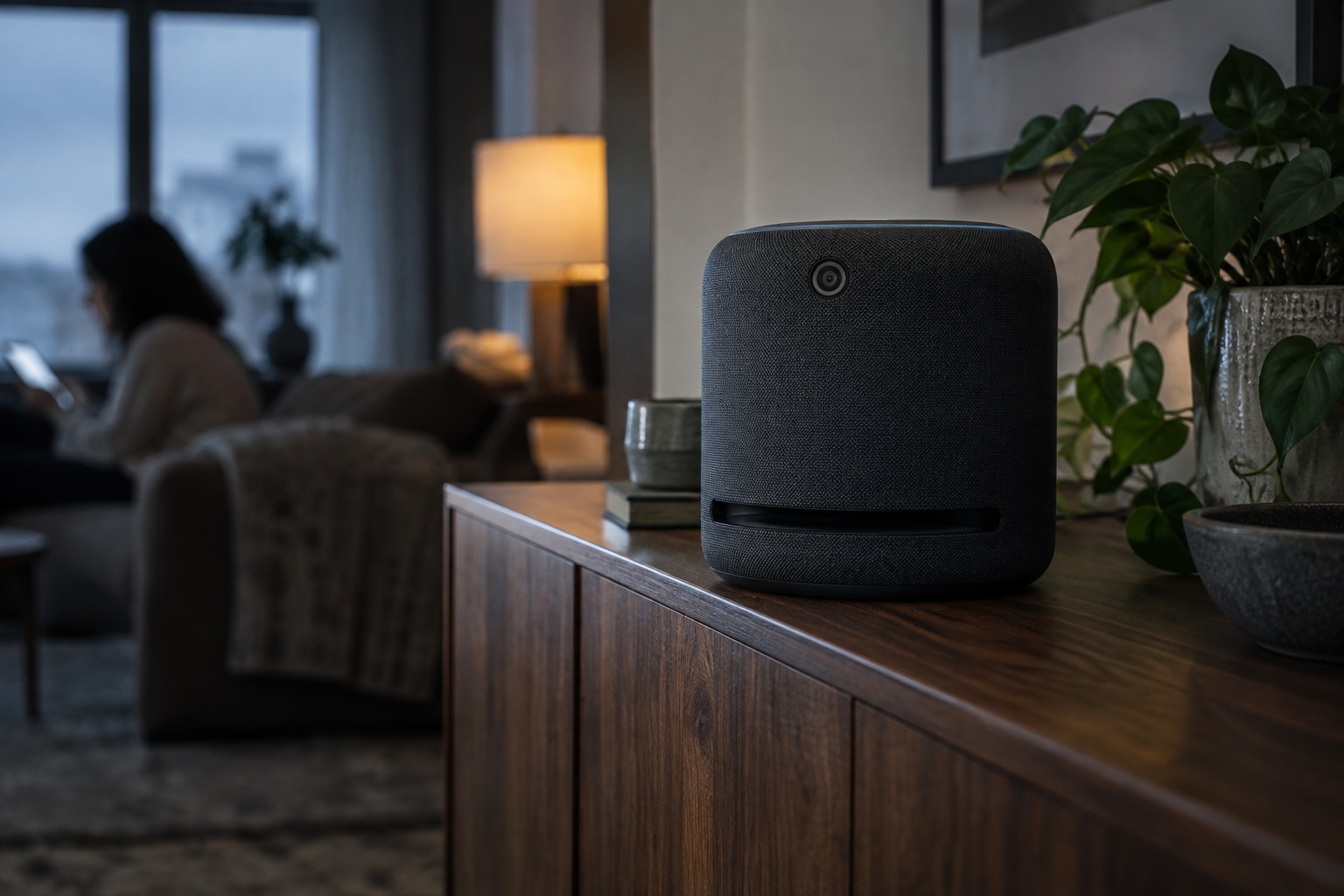
Amazon spent a decade putting microphones on your kitchen counter. Now it wants your eyes, your board game rules, and your breakfast cereal.
Meet the Echo Studio with Home Camera. It costs $250. That is a thirty-dollar surcharge over the standard edition for the privilege of mounting an optical sensor directly beneath your high-fidelity music stream.
Amazon rolled out the Echo Studio with Home Camera alongside a refreshed slate of Alexa devices. The core audio layout inside the cylindrical chassis remains largely untouched from previous hardware runs. You still get a single 3.75-inch high-excursion woofer pointed at your floorboards and three full-range drivers throwing sound across the room.
The hardware handles Dolby Atmos decoding and runs Amazon's custom spatial upmixing software to turn plain stereo tracks into simulated surround sound. Both the old studio unit and this optical hybrid support lossless HD audio streams.
Amazon also introduced an audio feature called Advanced Room Adaptation. The company claims the system actively measures room boundaries and continuously tweaks acoustic output to fight physical distortion. You get four far-field microphones embedded along the top rim to capture spoken commands while that acoustic calibration runs.
The real alteration sits right on the surface. Engineers jammed a 13MP camera into the enclosure without altering the physical dimensions of the original unit. Powering both the audio processing and the camera feeds is Amazon's proprietary AZ3 Pro processor, silicon introduced a year ago sporting a custom neural engine tailored specifically for the company's Alexa+ generative AI chatbot.
That 13MP sensor does more than sit idle waiting for a burglar. The hardware actively tracks your physical position inside the room. As you walk from the couch to the kitchen, the system recalculates your distance and shifts speaker volume so your audiobook maintains an identical loudness level relative to your ears.
Amazon also expects consumers to treat the speaker as an internal security sentry. Owners can boot up the smartphone companion app from an office desk or airport terminal to scan the living room, check on domestic pets, or confirm whether someone walked out the front door without flicking off the overhead lights.
The visual input feeds directly into Alexa+ for object identification tasks:
That Fire TV video conferencing link remains an unreleased promise. Amazon confirmed the pairing will arrive down the road, but declined to attach a firm calendar date to the firmware update.
Amazon introduced the original Echo Studio in 2019. Back then, the playbook was simple. Compete against premium shelf speakers from Sonos and Apple by giving Alexa users a heavy, loud cabinet with legitimate bass response and high-resolution playback capabilities.
The economic reality behind those devices turned grim. Amazon's hardware group built an empire of subsidized pucks and discount screens, but consumer habits failed to deliver downstream software revenue. Traditional Alexa interactions rarely produced e-commerce sales. The division reportedly burned billions of dollars over years of operation, serving as a massive digital balance-sheet drain.
Enter Alexa+. Amazon designed this generative AI overhaul to morph a money-losing voice assistant into an active commercial concierge. The goal is straightforward: build hardware sophisticated enough to handle multi-step domestic tasks, pull users into retail shopping flows, and extract transactional revenue.
Slapping a camera onto an audio-centric speaker brings immediate corporate baggage. Amazon owns Ring, a subsidiary that spent years defending its privacy practices. Ring previously handed user camera footage over to police departments without requiring homeowner permission or a judicial warrant.
The Federal Trade Commission later stepped in with formal legal charges. Regulators alleged that Amazon employees and offshore contractors improperly spied on private video feeds generated by customer cameras. Amazon resolved that FTC complaint with a $5.8 million settlement check while denying any legal wrongdoing.
That regulatory record explains why Amazon kept the camera-free Echo Studio on digital store shelves. The base model still retails for $220. If you prefer your living room speakers without an optical sensor linked to a cloud server, Amazon will happily take thirty dollars less of your money.
Amazon pitched the integration as an ambient visual assistant rather than a surveillance rig, highlighting how the lens collaborates with its new conversational engine.
Alexa can also see and understand what's in front of the camera and help you in real time.
To counter consumer unease about unblinking lenses in private living areas, Amazon emphasized its array of hardware-level privacy mechanisms. The top plate features a physical kill switch that cuts electrical power to both the microphone array and the 13MP sensor simultaneously.
The enclosure also includes a dedicated LED status light. Amazon stated that whenever the hardware captures images or transmits real-time video frames into the cloud infrastructure, the LED activates immediately to provide visible notice to everyone standing in the room.
Software controls offer a middle ground for suspicious buyers. Through the smartphone app, users can switch off the optical feed entirely. Product documentation confirms that Alexa voice processing remains operational on the device even when the visual capture module is disabled.
Skeptics look at the $5.8 million FTC settlement history and see a needless domestic risk. For privacy-conscious households, an always-connected camera perched inside a primary social room represents an unnecessary vulnerability, regardless of how neatly it tracks your cereal preferences.
Hardware purists have their own complaints. Audiophiles noticed that Amazon delivered zero meaningful acoustic driver upgrades over the previous generation. The physical drivers, the woofer specifications, and the internal acoustic volume are identical. The extra thirty dollars buys an optical pipeline, not a better soundstage.
The retail giant is running a clear experiment in domestic commerce. If Alexa+ can successfully turn physical household goods held in front of a 13MP camera into instant digital shopping carts, the hardware finally pays for itself. If users treat the lens as an invasive gimmick, Amazon is stuck selling expensive surveillance gear to people who just wanted to hear Fleetwood Mac in Dolby Atmos.
The pending integration with Amazon Fire TV sets up the next phase. Once the video calling link goes live, Amazon will attempt to turn your primary music speaker into the centerpiece of your family room communications, bridging screen and sound.
Amazon has to prove that the AZ3 Pro silicon and Alexa+ can process real-time visual data without turning living rooms into ad-targeting fishbowls. The standard Echo Studio remains on sale for $220 for a reason. Amazon knows plenty of customers will gladly sacrifice automatic volume tracking if it means keeping corporate eyes out of their homes.
Amazon spent billions bankrolling voice hardware that failed to drive digital sales. The Echo Studio with Home Camera is the physical face of the Alexa+ turnaround effort. By tethering an optical sensor directly to an AI retail engine, Amazon wants to bypass manual search entirely. If holding an empty box in front of a speaker replaces typing on a phone, voice hardware becomes a storefront rather than a balance-sheet write-off.
Reported off Ars Technica. Original reporting and analysis by Ray Dalton for Vox Roboti.
The Echo Studio with Home Camera costs $250. That is $30 more than the camera-free standard Echo Studio, which sells for $220.
Yes. Amazon continues to sell the standard camera-free Echo Studio for $220 for customers who prefer complete visual privacy.
The device features a built-in 13MP camera powered by an AZ3 Pro processor designed to run the Alexa+ AI engine.
The 13MP sensor detects your physical location in the room and adjusts audio output so sound levels remain consistent as you move around.
Yes. You can hold up items like a cereal box, and Alexa+ will identify the product to help you reorder replacements.
You can press the physical button on the unit to cut power to microphones and cameras, or disable the lens through the Alexa app.
Amazon confirmed future Fire TV video calling support, but has not announced an official release date for the integration.
Selma Ortiz · 15h ago · 4 min read

Cass Iverson · 2d ago · 5 min read

Selma Ortiz · 2d ago · 5 min read